
Paragraph 7
Marriage, Children & the Roles of Mothers and Fathers
Marriage and family are central to God’s eternal plan and family happiness is built in Jesus Christ, covenants, and the loving responsibilities of fathers and mothers.
160 scriptures81 scholarship30 stories123 resources
The family is ordained of God.
Read this line in context →Scriptures
In thee shall all families of the earth be blessed.
Thy seed shall be as the dust of the earth, and thou shalt spread abroad, … and in thee and in thy seed shall all the families of the earth be blessed.
I [will] be the God of all the families of Israel, and they shall be my people.
I bow my knees unto the Father of our Lord Jesus Christ, of whom the whole family in heaven and earth is named.
The Church of Jesus Christ of Latter-day Saints is properly known as a family-centered Church. But what is not well understood is that our family-centeredness is focused on more than mortal relationships. Eternal relationships are also fundamental to our theology. “The family is ordained of God.” Under the great plan of our loving Creator, the mission of His restored Church is to help the children of God achieve the supernal blessing of exaltation in the celestial kingdom, which can be attained only through an eternal marriage between a man and a woman (see Doctrine and Covenants 131:1–3). President Dallin H. Oaks, “Truth and the Plan.” General Conference, October 2018.
source neededThe gospel plan each family should follow to prepare for eternal life and exaltation is outlined in the Church’s 1995 proclamation, “The Family: A Proclamation to the World.” Its declarations are, of course, visibly different from some current laws, practices, and advocacy of the world in which we live. In our day, the differences most evident are cohabitation without marriage, same-sex marriage, and the raising of children in such relationships. Those who do not believe in or aspire to exaltation and are most persuaded by the ways of the world consider this family proclamation as just a statement of policy that should be changed. In contrast, Latter-day Saints affirm that the family proclamation defines the kind of family relationships where the most important part of our eternal development can occur.
Families are an echo of a celestial pattern and emulation of God’s eternal family. Families are not just meant to make things run more smoothly here on earth and to be cast off when we get to heaven. Rather, they are the order of heaven. They are an echo of a celestial pattern and an emulation of God’s eternal family.
The social science case for marriage and for families headed by a married man and woman is compelling. And so “we warn that the disintegration of the family will bring upon individuals, communities, and nations the calamities foretold by ancient and modern prophets.” But our claims for the role of marriage and family rest not on social science but on the truth that they are God’s creation. It is He who in the beginning created Adam and Eve in His image, male and female, and joined them as husband and wife to become “one flesh” and to multiply and replenish the earth. Each individual carries the divine image, but it is in the matrimonial union of male and female as one that we attain perhaps the most complete meaning of our having been made in the image of God—male and female.
Neither we nor any other mortal can alter this divine order of matrimony. It is not a human invention. Such marriage is indeed “from above, from God” and is as much a part of the plan of happiness as the Fall and the Atonement.
As the world slips away from the Lord’s law of chastity, we do not. President Monson said: “The Savior of mankind described Himself as being in the world but not of the world. We also can be in the world but not of the world as we reject false concepts and false teachings and remain true to that which God has commanded.
While many governments and well-meaning individuals have redefined marriage, the Lord has not. In the very beginning, God initiated marriage between a man and a woman—Adam and Eve. He designated the purposes of marriage to go far beyond the personal satisfaction and fulfillment of adults to, more importantly, advancing the ideal setting for children to be born, reared, and nurtured.
Understanding the eternal nature of the family is a critical element in understanding Heavenly Father’s plan for His children. … Our eternal happiness is not one of Satan’s objectives. He knows that an essential key to making men and women miserable like himself is to deprive them of family relationships which have eternal potential. Because Satan understands that true happiness in this life and in the eternities is found in the form of family, he does everything in his power to destroy it.
Stories
Taralyn’s story

I’ve always seen the Family Proclamation as a beautiful painting – an ideal to aim for. Something that’s created and achieved over a lifetime and into the eternities, rather than some ideal to reach and check off my list. I’ve studied it as a young, single adult, questioning her ability to ever create that ideal. I’ve studied it as a wife and mom, who looks like she’s “arrived.” But the truth is, every version of me could find faults and judgement and weaknesses if she looked to compare herself with the ideal. But I don’t see it that way – I see it as a reminder of God’s promises. Am I imperfect, flawed, and broken? Absolutely. Could parts of the Family Proclamation make me feel marginalized or misunderstood? Most certainly. But the Proclamation isn’t about me. God’s beautiful painting is about Him, not me, and I appreciate that no matter what stage I’ve been in, I’ve been able to find myself in it. The Proclamation actually led me to my specific Master’s program. After years of working with at-risk youth, I knew I wanted to do more with families. I hated seeing them go home to brokenness that undid the work they did in treatment. But I also loved wilderness therapy, and wanted to find something that married all of that. That bit about “wholesome recreational activities” directly led me to my Master’s Program in Youth and Family Recreation. Because whether I helped other families with that or wound up getting married and starting my own family, I knew the added education would flesh out that piece of God’s painting for me. I have also felt heartache over how some of God’s children feel reading some of the declarations in the Proclamation, but I also believe those firm declarations give us opportunities to see where/how we can grow, and also to see where we need to invite and allow Christ’s Atonement to heal and empower us. Within God’s beautiful painting, there is a place for all of us.
source needed

Scholarship
The contribution of gender complementarity to child rearing is deeply rooted in the innate differences between men and women. The Harvard sociologist Pitirim Sorokin (1956) concluded that no society has ceased to honor the institution of marriage and survived. Traditional marriage and parenting contributes to the fulfillment of life’s meaning to both individuals and society. Enjoying the marital union in its infinite richness, parents freely fulfill many other paramount tasks. They maintain the procreation of the human race. Through their progeny, they determine the hereditary and acquired characteristics of future generations. Through marriage they achieve a social immortality of their own, of their ancestors, and of their particular groups and community. This immortality is secured through the transmission of their name and values and of their traditions and ways of life to their children, grandchildren, and later generations.
There is no fact that has been established by social science literature more convincingly than the following: all variables considered, children are best served when reared in a home with a married mother and father. David Popenoe (1996) summarized the research nicely:
Social science research is almost never conclusive … yet in three decades of work as a social scientist, I know of few other bodies of data in which the weight of evidence is so decisively on one side of the issue: on the whole, for children, two-parent families are preferable to single-parent and step-families. Children navigate developmental stages more easily, are more solid in their gender identity, perform better in academic tasks at school, have fewer emotional disorders and become better functioning adults when they are reared by dual-gender parents.
This conclusion, supported further by a plethora of research spanning decades, clearly demonstrates gender-linked differences in child-rearing that are protective for children. That is, men and women contribute differently to the healthy development of children. … mothers and fathers are essential for optimal childrearing. Gender complementarity affords children the opportunity to thrive in the best possible environment.” Journal of Law & Family Studies, 6(2),
Family relationships are the first a person experiences in life. Children are nurtured, taught, and socialized in the family, and from there learn to relate to others and participate in the broader society. A stable family offers the emotional security a child needs for healthy development. As Princeton University sociologist Sara McLanahan has noted:
If we were asked to design a system for making sure that children’s basic needs were met, we would probably come up with something quite similar to the two-parent ideal. Such a design, in theory, would not only ensure that children had access to the time and money of two adults, it also would provide a system of checks and balances that promoted quality parenting. The fact that both parents have a biological connection to the child would increase the likelihood that the parents would identify with the child and be willing to sacrifice for that child.
The consequences of our current retreat from marriage is not a flourishing libertarian social order, but a gigantic expansion of state power and a vast increase in social disorder and human suffering. The results of the marriage retreat are not merely personal or religious. When men and women fail to form stable marriages, the first result is a vast expansion of government attempts to cope with the terrible social needs that result. There is scarcely a dollar that state and federal government spends on social programs that is not driven in large part by family fragmentation: crime, poverty, drug abuse, teen pregnancy, school failure, mental and physical health problems. …
Marriage is a universal human institution. We do not know of any culture that has survived without a reasonably functional marriage system. … The future belongs to people who do the hard things necessary to reproduce not only themselves, but their civilization. Marriage is not an option, it is a precondition for social survival. Not everyone lives up to the marriage ideal in this or any civilization. But when a society abandons the marriage idea altogether as a shared public norm, do not expect private individuals to be able to sustain marriage. … Losing this battle means losing the idea that children need mothers and fathers. It means losing marriage. It means losing limited government. It means losing civilization. It means losing, period.
Resources
The family has been the ultimate foundation of every civilization known to history. It [is] the economic and productive unit of society … it [is] the political unit of society, with parental authority as the supporting microcosm of the state; it [is] the cultural unit, transmitting letters and arts, rearing and teaching the young; and it [is] the moral unit, inculcating through cooperative work and discipline those social dispositions which are the psychological basis and cement of civilized society”.
The family has the primary responsibility for the nurturing and protection of children from infancy to adolescence. For the full and harmonious development of their personality, children should grow up in a family environment, in an atmosphere of happiness, love and understanding. All institutions of society should respect and support the efforts of parents to nurture and care for children in a family environment. Parents have a prior right to choose the kind of education that shall be given to their children and the liberty to ensure the religious and moral education of their children in conformity with their own convictions.
The family is the natural and fundamental group unit of society and is entitled to protection by society and the State.
The Proclamation reaffirms long-standing values regarding marriage, the roles of husbands and wives, and the duties and obligations of family members. However, the Proclamation is not a static, regressive document. As its plain terms emphasize, there is a pressing need for husbands and wives to protect, promote, and improve the lives of family members—particularly those of women and children. The Proclamation unequivocally affirms that there are social norms, traditions, and beliefs associated with family life.
The family, a universal community based on the marital union of a man and a woman, is the bedrock of society, the strength of our nations, and the hope of humanity.
The widest possible protection and assistance should be accorded to the family, which is the natural and fundamental group unit of society.
Marriage between man and woman is essential to His eternal plan.
Read this line in context →No resources yet for this phrase.
Children are entitled to birth within the bonds of matrimony, …
Read this line in context →Scriptures
To avoid fornication, let every man have his own wife, and let every woman have her own husband.
Ye shall not afflict any … fatherless child.
Your God … doth execute the judgment of the fatherless … in giving him food and raiment.
Thou shalt not pervert the judgment of … the fatherless. … When thou cuttest down thine harvest in thy field, and hast forgot a sheaf in the field, thou shalt not go again to fetch it: it shall be … for the fatherless. … When thou beatest thine olive tree, thou shalt not go over the boughs again: it shall be … for the fatherless. … When thou gatherest the grapes of thy vineyard, thou shalt not glean it afterward: it shall be … for the fatherless.
A father of the fatherless … is God in his holy habitation. … Defend the poor and fatherless: do justice to the afflicted and needy.
We are orphans and fatherless, our mothers are as widows.
Pure religion and undefiled before God and the Father is this, To visit the fatherless … in their affliction.
Jesus saith unto her, Go, call thy husband, and come hither. The woman answered and said, I have no husband. Jesus said unto her, Thou hast well said, I have no husband: for thou hast had five husbands; and he whom thou now hast is not thy husband: in that saidst thou truly. The woman saith unto him, Sir, I perceive that thou art a prophet. … Jesus saith unto her, … True worshippers shall worship the Father in spirit and in truth: for the Father seeketh such to worship him. … The woman then … went her way into the city, and saith to the men, Come, see a man, which told me all things that ever I did: is not this the Christ? Then they went out of the city, and came unto him. … And many of the Samaritans of that city believed on him for the saying of the woman, which testified, He told me all that ever I did. … And many more believed … and said unto the woman, Now we believe, not because of thy saying: for we have heard him ourselves, and know that this is indeed the Christ, the Saviour of the world.
The people of Nephi … began to grow hard in their hearts, and indulge themselves somewhat. … Thus saith the Lord: This people … seek to excuse themselves. … I the Lord God will not suffer that this people shall do like unto them of old. … For I, the Lord God, delight in the chastity of women. … This people shall keep my commandments. … Concubines they should have none.
A home with a loving and loyal husband and wife is the supreme setting in which children can be reared in love and righteousness and in which the spiritual and physical needs of children can be met. Just as the unique characteristics of both males and females contribute to the completeness of a marriage relationship, so those same characteristics are vital to the rearing, nurturing, and teaching of children.
The doctrine is clear—and is substantiated by years of research. We don’t need to return to the family laws of yesteryear, but if we could just care more about our children and their future, people would marry before becoming parents. They would sacrifice more, much more, to stay married. Children would be raised, whenever possible, by their biological parents. … Yet in principle, the 1995 proclamation on the family says it perfectly: “Children are entitled to birth within the bonds of matrimony, and to be reared by a father and a mother who honor marital vows with complete fidelity.
[God’s] vision of marriage as a holy order based on enduring covenants, duties, and lifelong sacrifice stands in stark contrast to a modern secular concept of marriage. That worldly formulation has virtually nothing to do with losing your life in service to family or in self-sacrifice for spouse and children. …
Never has a global society placed so much emphasis on the fulfillment of romantic and sexual desires as the highest form of personal autonomy, freedom, and self-actualization. Society has elevated sexual fulfillment to an end in itself rather than as a means to a higher end. In this confusion, millions have lost the truth that God intended sexual desire to be a means to the divine ends of marital unity, the procreation of children, and strong families, not a selfish end in itself.
We are losing the basic understanding that society has a unique and profound interest in marriage because of its power to form a male-female union that is the optimal setting for the bearing and rearing of children—ensuring to the greatest extent possible that every child has an opportunity to know and to be loved and cared for by the mother and father who brought him or her into the world.
Honour thy father and thy mother: that thy days may be long upon the land which the LORD thy God giveth thee.
The fear of the Lord is the beginning of knowledge. … My son, hear the instruction of thy father, and forsake not the law of thy mother.
My son, keep thy father’s commandment, and forsake not the law of thy mother.
Hearken unto thy father that begat thee, and despise not thy mother when she is old. … He that begetteth a wise child shall have joy of him. Thy father and thy mother shall be glad, and she that bare thee shall rejoice.
They never had fought, yet they did not fear death; and they did think more upon the liberty of their fathers than they did upon their lives; yea, they had been taught by their mothers, that if they did not doubt, God would deliver them.
Children need the emotional and personal strength that comes from being raised by two parents who are united in their marriage and their goals. As one who was raised by a widowed mother, I know firsthand that this cannot always be achieved, but it is the ideal to be sought whenever possible… We also need politicians, policy makers, and officials to increase their attention to what is best for children in contrast to the selfish interests of voters and vocal advocates of adult interests.
Children are also victimized by marriages that do not occur. Few measures of the welfare of our rising generation are more disturbing than the recent report that 41 percent of all births in the U.S. were to women who were not married. Unmarried mothers have massive challenges, and the evidence is clear that their children are at a significant disadvantage when compared with children raised by married parents.
Stories
The difficult reality is that the natural family and sexual liberation are mutually exclusive. The more there is of the one, the less there will be of the other.
At its most basic level, marriage is about attaching a man and a woman to each other as husband and wife to be father and mother to any children their sexual union produces. When a baby is born, there is always a mother nearby: That is a fact of reproductive biology. The question is whether a father will be involved in the life of that child and, if so, for how long. Marriage increases the odds that a man will be committed both to the children that he helps create and to the woman with whom he does so.
Marriage, rightly understood, brings together the two halves of humanity (male and female) in a monogamous relationship. Husband and wife pledge to each other to be faithful by vows of permanence and exclusivity. Marriage provides children with a relationship with the man and the woman who made them.
Scholarship
Marriage is linked to higher levels of health and happiness and lower levels of alcohol and drug abuse for both adults and teens. Marriage is a wealth-creating institution – married people earn more, save more, and build more wealth, compared to people who are single or living together. There is an inverse relationship between marriage and crime – in communities where marriage is common, crime is much less common. Marriage is our most pro-child institution. It is our society’s best arrangement for helping children to thrive.
Marriage strengthened the bonds between fathers and their children. Married men were more involved and had better relationships with their children than unwed or divorced fathers. In part, this was because married fathers shared the same residence with their children. But it was also because the role of husband encourages men to voluntarily take responsibility for their own children.
Relationships are more complex and less stable in families that are formed by unmarried parents. These families are much more likely to include children from other partnerships, and parents’ relationships are more fragile. Nearly half the cohabiting mothers (and nearly 80% of the non-cohabiting unmarried mothers) have ended their relationships with their child’s fathers by the time their children are 3 years old. Poverty rates and unemployment are also higher in unmarried-parent families. Sociological theory tells us that father absence reduces children’s access to social capital.
What adults do in their relationships affects, feeds into, and impacts their relationships with children, even biological ones.
The biological child of cohabitants consistently received smaller investments from their fathers than a biological child of married parents, in both blended and nonblended households. …The differences persisted for biological children after controlling for other socioeconomic factors, even in blended families. … Marriage is differentiating the investments fathers make intheir children. …
Evidence shows the least safe of all environments for children is that in which the mother is living with someone other than the child’s biological father. This is the environment for the majority of children in cohabiting couple households.
— David Popenoe and Barbara Dafoe Whitehead, “Should We Live Together? What Young Couples Need to Know about Cohabitation Before Marriage,” National Marriage Project
source neededUsing nationally representative data from the U.S. National Survey of Families and Households (NSFH) to examine the association between family structure and child well-being … our findings showed that cohabiting parents were closer to single parent families than married parent families in terms of economic disadvantage. We also found that differences in economic resources accounted for much more of the disadvantage associated with non-traditional family structures than differences in parenting, especially differences between single parent families and married parent families.
The children of divorced or unwed parents have about three times as many serious behavioral, emotional, and developmental problems as children in two-parent families. By every measure of child well-being, these children are far worse off. And when children are dysfunctional, society becomes dysfunctional.
Ellis, McFadyen-Ketchum, Dodge, Pettit and Bates (1999) conducted a longitudinal study to test Belsky’s evolutionary model of menarcheal [onset of menstration/sexual maturation] timing. These researchers observed 173 girls and their families for eight years to determine if more negative-coercive family relationships in early childhood provoke earlier reproductive development in adolescence. It was found that the quality of a fathers’ investment in the family was the most important aspect of the proximal family environment relative to influencing a daughter’s pubertal timing. Girls reared in father-absent homes reached menarche several months earlier than their peers in father-present homes. The longer the paternal absence, the earlier was the onset of puberty. … The greater the time spent by fathers in child care and the greater the level of father- daughter affection, the more delayed was the onset of menarche.
… and to be reared by a father and a mother …
Read this line in context →Scholarship
Nearly three decades of research evaluating the impact of family structure on the health and well-being of children demonstrates that children living with their married, biological parents consistently have better physical, emotional, and academic well-being. Pediatricians and society should promote the family structure that has the best chance of producing healthy children. The best scientific literature to date suggests that, with the exception of parents faced with unresolvable marital violence, children fare better when parents work at maintaining the marriage.
There are clearly negative long-term consequences of divorce—children, parents, and society all suffer. … Given these tremendous costs borne by all individuals affected by divorce, as well as the costs to society, it is the responsibility of physicians—especially pediatricians, who care for children in the context of their families—to advocate for public health policies that promote marriage and decrease the likelihood of divorce.”
Few propositions have more empirical support in the social sciences than this one: compared to all other family forms, families headed by married, biological parents are best for children.
— David Popenoe, “The Scholarly Consensus on Marriage,” Center for Marriage and Family at the Institute for American Values Fact Sheet #2, Feb 2006
source neededLongstanding research assert(s) the view that the ideal environment for raising children is a stable biological mother and father. The science on comparative parenting structures, especially the research on same-sex households, is relatively new. Therefore, a claim that another parenting structure provides the same level of benefit should be rigorously tested and based on sound methodologies and representative samples. … it is reasonable to conclude that a mother and father function as a complementary parenting unit and that each tends to contribute something unique and beneficial to child development … Current research on the psycho-social development of children continues to affirm that the complementarity of an intact family, with a mother and a father serving unique relational roles, is optimal for a child’s healthy development.
The Kids Aren’t All Right: New Family Structures and the ‘No Differences’ Claim,
Redefining marriage … further distance[s] marriage from the needs of children and would deny … the ideal that a child needs both a mom and a dad. Decades of social science, including the latest studies using large samples and robust research methods, show that children tend to do best when raised by a mother and a father.
The New Consensus that Marriage Matters. A large body of social science research indicates that healthy, married-parent families are an optimal environment for promoting the well-being of children. Children raised by both biological parents are less likely than children raised in single- or step-parent families to be poor, to drop out of school, to have difficulty finding a job, to become teen parents or to experience emotional or behavioral problems.
Adolescents in single-parent families are significantly more delinquent than their counterparts residing with two biological, married parents. … But the effects of family structure are largely mediated by family processes, such as parental monitoring, supervision, and closeness. … Parental closeness coupled with involvement, supervision, and monitoring, attenuate the effect of living in a single-parent (or step) family on delinquency. Given that a growing share of America’s youth spends some time in a single-parent family, it is imperative that parents (as well as families and communities more generally) strive to provide their children with a strong balance of nurture and control to minimize delinquent behavior, particularly the more serious forms to which adolescents in single-parent families appear to be especially susceptible.
Despite government spending over $22 trillion on anti-poverty programs since the 1960s War on Poverty began, the child poverty rate has barely decreased: from 20.7 percent in 1965 to 19.2 percent in 2015. The War on Poverty largely failed because it ignored the role of marriage in reducing poverty. Poverty is most prevalent in non-intact families. According to the U.S. Census Bureau, single-parent families are significantly more likely to fall into poverty than are married-couple families:
source neededOver 2 million children reside in single-parent families. Never married single mother families constitute the greatest portion of single parent families. While the share of divorced and separated single mothers has decreased in recent years (although the numbers are still high), the share of never married single mothers continues to rapidly rise. This trend is particularly alarming because, of all family structures, children of never married mothers are the most likely to experience poverty. In 2015, 49.8 percent of children under age 18 who lived with a never married mother were in poverty. It is also notable in the chart above that cohabitation seems to make little difference in lowering the poverty rate.
… who honor marital vows …
Read this line in context →Scriptures
Have ye not read, that he which made them at the beginning made them male and female, and said, For this cause shall a man leave father and mother, and shall cleave to his wife: and they twain shall be one flesh? Wherefore they are no more twain, but one flesh. What therefore God hath joined together, let not man put asunder. … Moses because of the hardness of your hearts suffered you to put away your wives: but from the beginning it was not so.
Unto the married I command, yet not I, but the Lord, Let not the wife depart from her husband. … Art thou bound unto a wife? Seek not to be loosed.
The woman which hath an husband is bound by the law to her husband so long as he liveth.
Such a total union, such an unyielding commitment between a man and a woman, can only come with the proximity and permanence afforded in a marriage covenant.
The blessings of covenant belonging come when we follow the Lord’s prophet and rejoice in temple-covenant living, including in marriage. Covenant marriage becomes supernal and eternal as we daily choose the happiness of our spouse and family before our own. As “me” becomes “we,” we grow together. We grow old together; we grow young together. As we bless each other across a lifetime of forgetting ourselves, we find our hopes and joys sanctified in time and eternity.
Scholarship
Marriage benefits individuals, families, and society. Social science research shows its many positive effects:
- Married men earn up to 26 percent more than their unmarried counterparts. • Women in intact marriages have relatively more money to take care of their families’ needs than women in any other family structure. • Marriage protects against feelings of loneliness. • Married people are happier in their relationships and report less depression than those who cohabit. • Married people are more likely to report better health, a difference that also holds for the poor.
… with complete fidelity.
Read this line in context →Scriptures
Thou shalt not commit adultery. … Thou shalt not covet thy neighbour’s wife.
Thou shalt love thy wife with all thy heart, and shalt cleave unto her and none else. And he that looketh upon a woman to lust after her shall deny the faith, and shall not have the Spirit; and if he repents not he shall be cast out. Thou shalt not commit adultery; and he that committeth adultery, and repenteth not, shall be cast out. But he that has committed adultery and repents with all his heart, and forsaketh it, and doeth it no more, thou shalt forgive.
Thou shalt not … commit adultery, … nor do anything like unto it.
It was said by them of old time, Thou shalt not commit adultery: But I say unto you, That whosoever looketh on a woman to lust after her hath committed adultery with her already in his heart.
Whether we like it or not, so many of the difficulties which beset the family today stem from the breaking of the seventh commandment (see Ex. 20:14). Total chastity before marriage and total fidelity after are still the standard from which there can be no deviation without sin, misery, and unhappiness. The breaking of the seventh commandment usually means the breaking of one or more homes.
Scholarship
Younger Americans could be putting their relationships at risk with looser relationship boundaries online, according to “iFidelity: The State of Our Unions 2019,” the National Marriage Project at the University of Virginia and the School of Family Life at Brigham Young University. … The report presents a survey of relationship attitudes and behaviors online and in real life. This is the first generational overview of how Americans think about sexual fidelity online in the wake of the internet revolution and the first study of the links between sexual fidelity online and relationship quality among American men and women. … It included participants from Generation X and the millennial, baby boomer and silent/greatest generations.
Among the findings:
- Although a clear majority of Americans in all generations express support for sexual fidelity in their relationships and report they are sexually faithful in real life, today’s young adults are markedly more likely to cross online boundaries related to sex and romance. For example, 18% of millennial participants engaged in sexual talk online with someone besides their partner, compared to 3% of greatest/silent generation participants, 6% of baby boomers, and 16% of Gen Xers.
- Several online behaviors are rated by most Americans (70% or more) as “unfaithful” or “cheating,” including having a secret emotional relationship or sexting with someone other than a partner/spouse without the partner’s/spouse’s knowledge and consent.
- Married and cohabiting men and women who maintain strong boundaries online against potential sexual and romantic alternatives are more likely to be happy in their relationships.
Those currently married or cohabiting who blur these boundaries online are significantly less happy, less committed and more likely to break up, while, conversely, those taking a more careful stance to attractive alternatives online are happier, more committed and less likely to separate.
According to the Marriage and Religion Research Institute’s “Mapping America” adults aged 18 to 59 in intact marriages who worshiped weekly were least likely to have ever cheated on their spouse or cohabiting partner, according to the National Health and Social Life Survey, the most detailed analysis of sexual behavior in America.
With the exception of two religious groups (nontraditional conservatives and non-Christian faiths), holding any religious affiliation is associated with reduced odds of marital infidelity compared to those with no religious affiliation. …This robust protective effect may be due to several factors. Regular participation in worship services may reinforce religious plausibility structures and belief systems; thus, persons who internalize these religious values and norms may be dissuaded from indulging any temptation. …
Our findings suggest that specific theological beliefs, specifically views about the Bible, are also directly related to infidelity. Persons who agree that the Bible is the literal word of God are less prone to engage in marital infidelity than their counterparts who ascribe no sacred significance to the Bible, and this relationship persists even with controls for religious affiliation and frequency of attendance at services. Likewise, persons who regard the Bible as the inspired (but not literal) word of God are also less inclined toward infidelity than nonbelievers. Our findings suggest that such biblical beliefs may translate into greater resistance to sexual temptation on the part of married persons. This suggests that doctrines of moral conservatism and restraint are associated with real differences in personal behavior rather than simply beliefs.
Happiness in family life is most likely to be achieved when founded upon the teachings of the Lord Jesus Christ.
Read this line in context →Scriptures
Happy is that people, whose God is the Lord.
Whoso trusteth in the Lord, happy is he.
If I then, your Lord and Master, have washed your feet; ye also ought to wash one another’s feet. For I have given you an example, that ye should do as I have done to you. … If ye know these things, happy are ye if ye do them.
It is given unto you to judge, that ye may know good from evil; and the way to judge is as plain, that ye may know with a perfect knowledge, as the daylight is from the dark night. For behold, the Spirit of Christ is given to every man, that he may know good from evil; wherefore, I show unto you the way to judge; for every thing which inviteth to do good, and to persuade to believe in Christ, is sent forth by the power and gift of Christ; wherefore ye may know with a perfect knowledge it is of God.
We count them happy which endure.
I, Nephi, did take my family … and all those who would go with me [who] were those who believed in the warnings and the revelations of God. … And we did observe to keep … the commandments of the Lord in all things. … And I, Nephi, had also brought the records … according to that which is written. And I did teach my people to build buildings, and to work. … And I, Nephi, did build a temple. … I, Nephi, did cause my people to be industrious, and to labor with their hands. … We lived after the manner of happiness.
Consider on the blessed and happy state of those that keep the commandments of God. For behold, they are blessed in all things, both temporal and spiritual; and if they hold out faithful to the end they are received into heaven, that thereby they may dwell with God in a state of never-ending happiness.
Do not suppose, because it has been spoken concerning restoration, that ye shall be restored from sin to happiness. Behold, I say unto you, wickedness never was happiness.
Blessed art thou and thy children. … Inasmuch as they shall keep my commandments they shall prosper in the land. … These promises have been verified to the people of Nephi; for it has been their quarrelings and their contentions, … their whoredoms, and their abominations, which were among themselves, which brought upon them their wars and their destructions. And those who were faithful in keeping the commandments of the Lord were delivered at all times, whilst thousands of their wicked brethren have been consigned to bondage, or to perish by the sword, or to dwindle in unbelief. … But behold there never was a happier time among the people of Nephi.
There was no contention in the land, because of the love of God which did dwell in the hearts of the people. And there were no envyings, nor strifes, nor tumults, nor whoredoms, nor lyings, nor murders, nor any manner of lasciviousness; and surely there could not be a happier people among all the people who had been created by the hand of God. There were no robbers, nor murderers, neither were there Lamanites, nor any manner of -ites; but they were in one, the children of Christ, and heirs to the kingdom of God.
He that is found guiltless before him at the judgment day [will] dwell in the presence of God in his kingdom, to sing ceaseless praises with the choirs above, unto … God, in a state of happiness which hath no end.
Finding there was greater happiness and peace and rest for me, I sought for the blessings of the fathers, … having been myself a follower of righteousness, desiring also to be one who possessed great knowledge, … and to be a father of many nations.
The ultimate end of all activity in the Church is that a man and his wife and their children can be happy at home and that the family can continue through eternity. All Christian doctrine is formulated to protect the individual, the home, and the family.
Teach children gospel principles. Teach them it pays to be good. Teach them there is no safety in sin. Teach them a love for the gospel of Jesus Christ and a testimony of its divinity. Teach your sons and daughters modesty and teach them to respect manhood and womanhood. Teach your children sexual purity, proper dating standards, temple marriage, missionary service, and the importance of accepting and magnifying Church callings. Teach them a love for work and the value of a good education. Teach them the importance of the right kind of entertainment, including appropriate movies, and videos, and music, and books, and magazines. Discuss the evils of pornography and drugs and teach them the value of living the clean life.
Stories
Not yet migrated to YouTube — legacy format can’t play in-browser.
Open video in a new tab.mkv — download to view until migrated to YouTube
Scholarship
In a study titled “Religiosity, self-control, and antisocial behavior: Religiosity as a promotive and protective factor” researchers Robert Laird, Loren Marks and Matthew Marrero explain that higher religiosity has been associated with more positive health outcomes and provides consistently lower rates of drug and alcohol abuse, risky sexual behavior and delinquency. They also note that “high levels of religiosity may protect individuals who are otherwise at risk of, or inclined to engage in, misbehavior or health-compromising behaviors.”
A 2018 study in the American Journal of Epidemiology examined how being raised in a family with religious or spiritual beliefs affects mental health. Harvard researchers had examined religious involvement within a longitudinal data set of approximately 5,000 people, with controls for socio-demographic characteristics and maternal health. The result? Children or teens who reported attending a religious service at least once per week scored higher on psychological well-being measurements and had lower risks of mental illness.
Weekly attendance was associated with higher rates of volunteering, a sense of mission, forgiveness, and lower probabilities of drug use and early sexual initiation. Pity then that the U.S. has seen a 20% decrease in attendance at formal religious services in the past 20 years, according to a Gallup report earlier this year. In 2018 the American Family Survey showed that nearly half of adults under 30 do not identify with any religion.
Nihilism is fertilizer for anxiety and depression, and being “realistic” is overrated. The belief in God—in a protective and guiding figure to rely on when times are tough—is one of the best kinds of support for kids in an increasingly pessimistic world. That’s only one reason, from a purely mental-health perspective, to pass down a faith tradition.
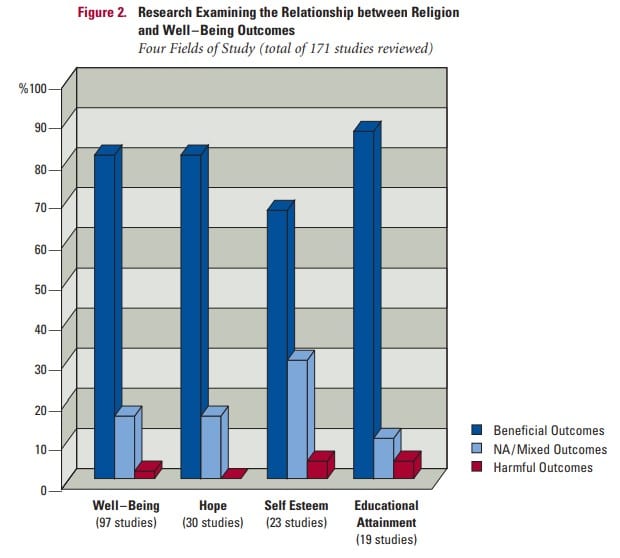
The vast majority of the studies, some 81 percent of the 99 studies reviewed, reported some positive association between religious involvement and greater happiness, life satisfaction, morale, positive affect or some other measure of well-being. The vast number of studies on religion and well-being have included younger and older populations as well as African Americans and Caucasians from various denominational affiliations:
We know the source but not the exact wording — follow the link to read it there.
Religious involvement predicted positive marital and parenting interactions for both generations examined. What has been under-studied, however, is why faith and families are such a robust combination. What is the magic at work here? …
Meaningful religious traditions … not only provide a sense of connection around the holidays, but families also report meaningful daily and weekly rituals. These include weekly Shabbat practices for Jewish families, weekly Family Home Evening for Latter-day Saint families, daily prayer (Salat) for Muslim families, family Bible reading for Evangelical Christian families, and regular forgiveness and confession for Catholic and Orthodox Christian families. Each of these practices yield myriad reported benefits. Religious involvement is especially helpful in supporting and strengthening minority families such as African American Christians and Asian American Christians.
Several studies have shown that religiosity is correlated with greater marital satisfaction and commitment, lower marital conflict, less divorce, and less infidelity. … For instance, a meta-analysis by Mahoney and colleagues (2001) demonstrated that church attendance did not decline after divorce; however, low attendance predicted divorce and high attendance was associated with lower risk for divorce. Thus, there are indications that religiosity promotes more stable and satisfying marital relationships more so than the reverse. …
[There is] a reciprocal relationship between marital happiness and church attendance. They showed that increases in church attendance predicted greater happiness and higher levels of happiness predicted increased church attendance. The findings of all these studies, however, are consistent with the proposition that religiosity appears to enhance the quality of marital relationships.”

Resources
As the cradle of life and love for each new generation, the family is the primary source of personal identity, self-esteem, and support for children. It is also the first and foremost school of life, uniquely suited to teach children integrity, character, morals, responsibility, service, and wisdom.
Successful marriages and families are established and maintained on principles of faith, prayer, repentance, forgiveness, respect, love, compassion, work, and wholesome recreational activities.
Read this line in context →Scriptures
Inasmuch as parents have children in Zion, or in any of her stakes which are organized, … teach them … to understand the doctrine of repentance, faith in Christ the Son of the living God, and of baptism and the gift of the Holy Ghost by the laying on of the hands.
Pray in your families unto the Father, always in my name, that your wives and your children may be blessed.
Adam and Eve, his wife, called upon the name of the Lord, and they heard the voice of the Lord from the way toward the Garden of Eden, speaking unto them, and they saw him not; for they were shut out from his presence. … And Adam and Eve, his wife, ceased not to call upon God.
Take up your cross, in the which you must pray vocally before the world as well as in secret, and in your family, and among your friends, and in all places.
Be diligent in preserving what thou hast, that thou mayest be a wise steward. … If thou art merry, praise the Lord with singing, with music, with dancing, and with a prayer of praise and thanksgiving. If thou art sorrowful, call on the Lord thy God with supplication, that your souls may be joyful.
The home and family have been the center of true civilization. Any distortion of the God-given program will bring dire consequences. The families worked together, played together, and worshiped God together.
Stories
Not yet migrated to YouTube — legacy format can’t play in-browser.
Open video in a new tab.mkv — download to view until migrated to YouTubeNot yet migrated to YouTube — legacy format can’t play in-browser.
Open video in a new tab.mkv — download to view until migrated to YouTubeDo wholesome recreation and family traditions actually lead to greater happiness in family life? Brian Hill, professor of Experience Design at Brigham Young University, discusses the science behind successful family traditions and rituals and why they are essential for strong families.
The Raising Family Podcast: Family Traditions and Wholesome Recreation
Scholarship
Regular family dinners, yearly vacations, and holiday celebrations contribute to the development of a strong sense of intergenerational self. This intergenerational self and the strength and guidance that seem to derive from it are associated with children’s increased resilience, better adjustment, and improved likelihood of overcoming challenges.
It is what happens during these events that is key: family storytelling. Sharing stories—stories about parents and grandparents, triumphs and failures—provides powerful models for children. Children understand who they are in the world through both their individual experience and through the filters of family stories that provide a sense of identity through historical time.”
Leisure activities play an important role in the lives of families, among couples, in parent-child relations, and in grandparent-grandchild relations. Researchers have found that leisure has a positive influence on family relationships by enhancing communication and cohesion among family members. … Generativity appears to develop across the life course and plays a central role in the family leisure experiences for both grandparents and their adult grandchildren.
Families are still considered to be the fundamental units of society and are perhaps the oldest and most important of all human institutions. Examinations of family leisure have consistently demonstrated a positive relationship between family recreation and aspects of family functioning such as satisfaction and bonding.
While preparing to initiate the Family Narratives Project at the Sloan Center for the Study of Myth and Ritual in American Life (MARIAL) at Emory University in Atlanta, Georgia, psychologists Marshall Duke and Robyn Fivush interviewed a veteran clinician with 30 years in practice. She told them, “I can tell which kids I’m working with are most likely to respond to treatment and benefit most from educational plans and adjustments. It’s the ones who know about their family history” (Duke, Lazarus, & Fivush, 2008, p. 268). She routinely asks children and adolescents a few questions, such as where their parents met or what sorts of jobs their grandparents had, and has observed over the years that those who knew such information have much stronger positive prognoses and better outcomes.
A systematic review found that eating frequent family meals was associated with better psychosocial outcomes for children and adolescents. Infrequent family meals were associated with disordered eating, alcohol and substance use, violent behaviour, and feelings of depression or thoughts of suicide.
There was a positive relationship between frequent family meals and increased self-esteem and commitment to learning or a higher grade point average. Findings also highlighted that females seemingly gained more protective effects from frequent family meals than males did.
Given that psychosocial dysfunction is one of the most common chronic conditions among children and adolescents, health care practitioners should educate families on the benefits of having regular meals together. In addition, practitioners should explore any obstacles that might exist to having family meals and discuss potential strategies for their implementation. Canadian family physician Medecin de famille canadien61
Understanding the power of family history opens new possibilities for those of us dedicated to improving the lives of children and families. A family is a team, and in recent years, many new techniques have been introduced to help teams function more effectively. … Feiler (2013) suggests that the single most important thing we can do for our family may be the simplest of all: develop a strong family narrative. …
To hear family stories, people need to sit down with one another and not be distracted. Some people have to talk and some have to listen. The stories need to be told over and over, and the times of sitting together need to be multiple and occur over many years. …
Parents are often busy doing things that they think are useful for their children and their family, but in fact, what is happening is that family members are growing very separate from each other. … Parents [need to] become aware of the value of telling their children family stories. Although the nightly traditional family dinner is extinct in many households, parents can take advantage of moments together with their children in the car, over a snack, or at bedtime.
Resources
<br />
By divine design, fathers are to preside over their families in love and righteousness …
Read this line in context →Scriptures
I would have you know, that the head of every man is Christ; and the head of the woman is the man; and the head of Christ is God.
No power or influence can or ought to be maintained by virtue of the priesthood, only by persuasion, by long-suffering, by gentleness and meekness, and by love unfeigned; by kindness, and pure knowledge, which shall greatly enlarge the soul without hypocrisy, and without guile—reproving betimes with sharpness, when moved upon by the Holy Ghost; and then showing forth afterwards an increase of love toward him whom thou hast reproved, lest he esteem thee to be his enemy.
[Be] one that ruleth well his own house, having his children in subjection with all gravity.
Fatherhood is much more than a social construct or the product of evolution. The role of father is of divine origin, beginning with a Father in Heaven and, in this mortal sphere, with Father Adam. The perfect, divine expression of fatherhood is our Heavenly Father.”
The most important of the Lord’s work you [fathers] will ever do will be the work you do within the walls of your own home.
Fathers, yours is an eternal calling from which you are never released. … A father’s calling is eternal, and its importance transcends time. It is a calling for both time and eternity. .
Stories
Not yet migrated to YouTube — legacy format can’t play in-browser.
Open video in a new tab.mkv — download to view until migrated to YouTubeNot yet migrated to YouTube — playing from the legacy site.
Scholarship
We may have rediscovered how important fathers are, but a boy today “does not simply grow into” a good father. As Anthony Esolen insightfully notes, motherhood is “a biological reality with cultural expression,” but fatherhood is “a cultural reality built on a biological foundation.” We as a society are responsible to build fathers. That means appreciating how a boy depends on lessons for healthy development that only other men, “who speak in his dialect,” can provide. It means a culture that appreciates and develops true masculinity, recognizing as David Gilmore found that for a man to be tender, he must be tough enough to fend off enemies; to be generous he must be intent and focused enough “to amass goods;” to be gentle, he must be able to confront danger; and to love he must be assertive and confident enough to win his wife, and protect his own. We have discovered the importance of fatherhood, now we need to better build and protect it.
There is a father absence crisis in America. According to the U.S. Census Bureau, 19.7 million children, more than 1 in 4, live without a father in the home. Consequently, there is a father factor in nearly all social ills facing America today.
Boys and girls who grow up with an involved father, as well as an involved mother, have stronger cognitive and motor skills, enjoy elevated levels of physical and mental health, become better problem-solvers, and are more confident, curious, and empathetic. They also show greater moral sensitivity and self-control.
As they grow, well-fathered children are substantially less likely to be sexually involved at an early age, have babies out of wedlock, or be involved in criminal or violent behavior. They are much more likely to stay in school, do well there, and go to college. …
An analysis of over 100 studies on parent-child relationships found that having a loving and nurturing father was as important for a child’s happiness, well-being, and social and academic success as having a loving and nurturing mother. Some studies indicated father-love was a stronger contributor to some important positive child well-being outcomes. Weinraub, in “Fatherhood: the Myth of the Second Class Parent,” states that “There is no doubt that fathers are important contributors to child development. In particular, fathers significantly affect the development of sex roles, cognitive abilities and achievement motivation.”
Thirty years of research suggests that the absence of the male parent is more likely to be the problem. The boys who are most at risk for juvenile delinquency and violence are boys who are physically separated from their fathers. The U.S. Bureau of the Census reports that in 1960 children living with their mother but not their father numbered 5.1 million; by 1996 the number was more than 16 million. As the phenomenon of fatherlessness has increased, so has violence. As far back as 1965 Senator Daniel Patrick Moynihan called attention to the social dangers of raising boys without benefit of a paternal presence. He wrote in a 1965 study for the Labor Department, “A community that allows a large number of young men to grow up in broken families, dominated by women, never acquiring any stable relationship to male authority, never acquiring any rational expectations about the future—that community asks for and gets chaos.”
The sociologist David Blankenhorn, in Fatherless America (1995), wrote, “Despite the difficulty of proving causation in the social sciences, the weight of evidence increasingly supports the conclusion that fatherlessness is a primary generator of violence among young men.” William Galston, a former domestic-policy adviser in the Clinton Administration who is now at the University of Maryland, and his colleague Elaine Kamarck, now at Harvard, concur. Commenting on the relationship between crime and one-parent families, they wrote in a 1990 institute report, “The relationship is so strong that controlling for family configuration erases the relationship between race and crime and between low income and crime. This conclusion shows up time and again in the literature.”
Research from the University of Pennsylvania found that children who feel a closeness and warmth with their father are twice as likely to enter college, 75 percent less likely to have a child in their teen years, 80 percent less likely to be incarcerated, and half as likely to show various signs of depression.
A white teenage girl from an advantaged background is five times more likely to become a teen mother if she grows up in a single-mother household than if she grows up in a household with both biological parents.
The likelihood that a young male will engage in criminal activity doubles if he is raised without a father and triples if he lives in a neighborhood with a high concentration of fatherless families.
The research is absolutely clear … the one human being most capable of curbing the antisocial aggression of a boy is his biological father.
Fathers are far more than just “second adults” in the home. Involved fathers – especially biological fathers – bring positive benefits to their children that no other person is as likely to bring. They provide protection and economic support and male role models. They have a parenting style that is significantly different from that of a mother and that difference is important in healthy child development.
Resources
We know the source but not the exact wording — follow the link to read it there.
Introduction Most who know me will probably hear the topic of this talk and think, “Of course! Why wouldn’t he speak on that? I mean, he studies and speaks on it all the time, so it’s an obvious choice!” Well, let me tell you that it wasn’t so obvious to me. I didn’t want to default into a topic. The purpose of the devotional speaker is to be the Lord’s instrument to deliver the message He wants delivered.
Because I know that our Father knows and loves each of you perfectly, like the prophet Alma, I have studied and pondered and “fasted and prayed many days that I might know these things of myself…” and to know what message the Lord would have me deliver to you.
I tell you this because I know that every person who stands at this podium has done the very same thing as I have, and I hope today you’ll receive the personal epistle the Lord has for you.
Disclaimer And now a quick disclaimer: What I share today about the importance of fathers in no way minimizes or takes away from the vital and sacred role of mothers. There is too much in our world today that is trying “to stir up the hearts of men [and women] with anger, one against another.” This is certainly not the Lord’s way!
With that, I invite the Holy Ghost to be with each of us as we learn together today.
Two Suffocating Experiences When I was about six years old, I had two different experiences that, at the time, felt like near-death experiences. The first happened at school. We were outside at recess when the bell rang telling us it was time to head back to class. Unfortunately, a bunch of us reached the door at the same time and there became a terrible bottle neck. I happened to be in the front of this traffic jam that had tripped onto the floor. Then a huge doggy pile began as more and more children reached the door. It was getting harder and harder to breathe at the bottom of this pile. I remember looking up and seeing one girl joyfully pushing other children on top of the pile! I desperately looked for someone—anyone—to help pull me out. Other children in front of me just stared in both amusement and horror. (Useless little…) Well, I made it out, obviously, but that traumatic event left me a little more untrusting of my classmates.
The second experience took place at a small water park about 15 minutes from my home. I remember riding down a water slide, plunging into the pool at the bottom, and then noticing that my feet couldn’t reach the bottom of the pool. The current from the water slides made it difficult to tread water for a child my size, who also lacked swimming experience. I struggled to stay afloat as I went under, came up, went under, and came up again. Just as before, it was getting more and more difficult to breathe, and I really felt that I wasn’t going to make it. Just as I was about to go under again, my Dad appeared. I don’t remember whether he reached into the water or jumped in altogether, but he saved me from what felt like certain death.
Now, in both instances I was being suffocated by my surroundings and was desperately looking for someone to rescue me. And even though I made it out alive, only at the water park did I experience comfort and assurance because my father was both near and attentive, presiding over my welfare, providing life-sustaining breath, and protecting me from a strong current.
The State of Boys, Men, and Fathers Today Tragically, brothers and sisters, millions of children today are being suffocated by evil influences in this fallen world without a father near or attentive to protect them. Let me explain:
Boys today are much more likely than girls to have discipline problems at school, to be misdiagnosed with ADHD, to dropout from high school and college, and to become addicted to video gaming, drugs, and pornography. Boys today are less likely than girls to graduate from college, earn a graduate degree, and own a home. Far fewer young men get married and stay married today than just a couple decades ago. Young adult men are more likely than young adult women to live with a parent than they are to live with a partner or spouse. Men are also more likely than women to commit suicide, break the law, and be in prison.
You can probably see how these trends are both a cause and an effect of fatherlessness. In the United States alone, over 40 percent of children are born to unwed mothers. And of the mothers that do marry, nearly half of those marriages will end in divorce, often resulting in a less involved or absent father. It is no wonder 24 million children in America, one out of three children, are growing up in biological father absent homes. If you think it has always been this way, think again! In 1960, 9 in 10 children resided with their two married parents. As I have reviewed the research on this, I have found that this absentee-dad epidemic is a social engine driving many of the serious problems in the world, including those previously mentioned regarding boys and young men. For example, there is evidence to suggest that fatherlessness is fueling poverty, abortion, child abuse, school dropouts, school shootings, obesity, cohabitation, divorce, and sexual exploitation, namely: pornography, sex trafficking, and prostitution (and I’m just getting started).
To make matters worse, the media that many of us consume often depicts men and fathers to be downright useless. Elder D. Todd Christofferson described it in these words:
In too many Hollywood films, TV and cable shows, and even commercials, men are portrayed as incompetent, immature, or self-absorbed. This cultural emasculation of males is having a damaging effect …. Some men and young men have taken the negative signals as an excuse to avoid responsibility and never really grow up.
Perhaps after hearing all this, you too are feeling suffocated and overwhelmed. You should.
Brothers and sisters, I testify to you that Satan—the father of contention and the father of all lies —has been behind this war on fathers for a long time. You had better believe that he and his followers know full well that “the family is central to the Creator’s plan for the eternal destiny of [God’s] children.”
All is Well in Zion Now brethren, you may hear about the state of men and fathers today and think to yourself, “That’s too bad for the rest of the world, but I don’t plan on fathering children out of wedlock and becoming incarcerated, and I am planning on graduating from college and avoiding my parents’ basement,” to which I would respond, “Good for you— but not good enough.” This kind of attitude can lead to complacency. The prophet Nephi warned us of this very thing:
And others will [Satan] pacify, and lull them away into carnal security, that they will say: All is well in Zion; yea, Zion prospereth, all is well—and thus the devil cheateth their souls, and leadeth them away carefully down to hell …. Therefore, wo be unto him that is at ease in Zion!
All is not well in Zion! We can’t believe that Latter-day Saints are immune to these problems. Not only is this belief false, it doesn’t invite us to look inward and examine ourselves to see where we can improve and what we are lacking. We can’t have the attitude like many parents watching the television show Supernanny, who derive comfort from the thought, “Well, at least I’m not as bad as those parents!” No, we cannot look to the world’s standards and trends and derive comfort from not being as bad. As the Lord has said, “For of him unto whom much is given much is required; and he who sins against the greater light shall receive the greater condemnation.”
Let me address one more idea that can breed apathy and indifference: It is my observation that in the culture of the Church, some of the men have bought into the idea that their only hope for exaltation is to find a woman who will drag them to the celestial kingdom kicking and screaming. This attitude may stem from a belief that men and fathers are inferior to women and mothers. I know nothing in the words of ancient and modern prophets that teaches men are the lesser gender and that fathers are the inferior parent.
No, brethren—it is by divine design that “mothers and fathers are obligated to help one another as equal partners.” Do not let our different roles and capacities allow us to misinterpret our worth or capability. Men, you are to compliment and complete women, not just the other way around. Remember the second half of the Apostle Paul’s declaration: “Neither is… the woman without the man, in the Lord.”
Yes, responsible men and fathers are vital for both children and society. But to Latter-day Saints, fathers are much more. Again from Elder Christofferson:
Some see the good of fatherhood in social terms, as something that obligates men to their offspring, impelling them to be good citizens and to think about the needs of others, supplementing “maternal investment in children with paternal investment in children.” . . . While these considerations are certainly true and important, we know that fatherhood is much more than a social construct or the product of evolution. The role of father is of divine origin, beginning with a Father in Heaven and, in this mortal sphere, with Father Adam. The perfect, divine expression of fatherhood is our Heavenly Father.
You Were Designed to be a Father Ironically, sometimes I think that we Latter-day Saints speak of wanting to become like our Heavenly Father by developing His knowledge and perfect attributes, without focusing on becoming what He is: a parent—more specifically, a father. Men, our inherent mental, physical, and spiritual capacities are not simply for us to grow from boys to men.
In a manual produced by the Church titled A Parent’s Guide, we read this profound doctrinal statement:
Since a major purpose of our mortal existence is to become like our Heavenly Father…and since eternal life with our Father will be lived in family units, the ultimate goal of a man or boy is to become an effective husband and father….
That is how men reach the full measure of their creation. I realize that in this fallen world, fatherhood won’t be a reality for all men for a variety of reasons. But that shouldn’t excuse us of working toward our eventual destiny whether in this life or the next. Brethren, if your goal is exaltation, your goal is fatherhood. As Elder Dyches taught us last week:
Never lose sight of your purpose on earth and your divine destiny.
Prepare for Fatherhood Now! When I started teaching at BYU-Idaho about seven years ago, I would occasionally play basketball at the I-Center with students. And, looking like a student myself back then, I more than once had a conversation that went something like this in between games when students would discover that I was a faculty member:
Student: “Whoa, I thought you were a student. What classes do you teach?”
Me: “Parenting (and other classes). You should take the class.”
Student: [awkward pause] “Yeah, maybe I’ll worry about that when I have kids.”
Me: “So you’re saying that you are willing to spend thousands of dollars and at least four years of your life learning to become the best _____ (fill in the blank) you can be, but when it comes to the most important work you’ll ever do and the purpose of your creation, you’re just going to wing it?”
Student: “Well…that’s not totally what I meant.”
Me: “Well, that’s what it totally sounds like, dude!”
Brethren, the time to start preparing for fatherhood was yesterday. But since that is not an option, how about today? Why not begin by seeing most everything you do in your life now as fatherhood preparation? This focus will give more purpose into the important things you are already doing such as your educational, professional, romantic, and other pursuits. A fatherhood focus will also provide both the wisdom and the strength to eliminate those things in your life that are unnecessary, distracting, or self-centered.
On the devotional discussion board, Lehi Estrada, a BYU-Idaho student from the Philippines put it this way:
One thing I had been experiencing lately is trying to set my priorities in order. As a college student, you can shift more of your focus on what class you are failing, or [your] calling or just “ resting” for a while. In setting priorities, I always remember…Him. Christ is a great example of what is the most important thing we could do today or tomorrow…. Setting priorities makes me accountable and prepares me to do impossible things.
To help with your preparation and priorities, I’d like to take you through a brief crash-course on fatherhood preparation. Did you know that the purpose of the Aaronic—or preparatory priesthood—was not simply to prepare you to hold the Melchizedek Priesthood? The oath and covenant and duties of the priesthood are to make us into righteous and capable fathers.
If you weren’t aware of that as a young man (as I was not), we can turn to “The Family: A Proclamation to the World” for a clear and concise description of what we should be preparing to be doing as fathers.
By divine design, fathers are to preside over their families in love and righteousness and are responsible to provide the necessities of life and protection for their families.” 13
Preside. Provide. Protect. I’m sure we’ve all heard these three “Ps” before, but it’s not enough to know about them. We need to:
Obtain a deeper understanding of each of these three principles
Know what each principle looks like in fatherhood and how to prepare for it. Determine if our current thoughts, attitudes, and behaviors are impeding or promoting fatherhood preparation
Let’s briefly explore each of these items in each of the three Ps. Now I know that we men have a tendency to compartmentalize things in life, and that is appropriate at times; however, it’s important to understand that presiding, providing, and protecting are not three discrete and disconnected principles. In fact, they appropriately overlap, promote, and reinforce each other. I encourage you to look for this overlap and these connections as we move through each principle.
Preside In a pamphlet produced by the church, it gives a terrific definition of what it means to preside:
Fatherhood is leadership, the most important kind of leadership. It has always been so; it always will be so.
President Ezra Taft Benson further explained:
As the patriarch in your home, you…must help create a home where the Spirit of the Lord can abide. Your place is to give direction to all family life. You should take an active part in establishing family rules and discipline.
Your homes should be havens of peace and joy for your family. Surely no child should fear his own father—especially a priesthood father. A father’s duty is to make his home a place of happiness and joy. He cannot do this when there is bickering, quarreling, contention, or unrighteous behavior. The powerful effect of righteous fathers in setting an example…is vital to the spiritual welfare of his children.
For a real-life example of how difficult this can be, let’s watch my own family in action. I recorded this video of my children about five years ago, and it was after a long day at the pool. Think about how you might preside in a situation like this.
There is beauty all around….” Notice that there was bickering, quarreling, and contention. Also notice that every child stated they were not ready for scripture study, including my son, Carter, who walked out of the room. So what is the proper response? If you think punishment, lecturing, or you’d just let your wife handle it, think again.
Brethren, learn to deal with chaos and know how to respond rather than react. Learn to influence rather than control others through persuasion, long-suffering, gentleness, meekness, and love. This can be practiced with those around you—especially with those whose opinions and personalities differ from your own. Unlike a video game, you won’t be able choose or manipulate your children’s personalities, strengths, and weaknesses, but you can choose how you see, respond to, and influence them. If you struggle with anger, taking the initiative, or learning from others, then perhaps picturing your future children will give you renewed purpose and strength to change.
Provide That brings us to providing the necessities of life. But what are the necessities? Temporally it might include food, water, clothing, a modest home, and a good education. This is a good start, but let us not forget the most universal human need: love. As President Dieter F. Uchtdorf has said, “In family relationships love is really spelled t-i- m-e, time.” When children of varying ages are asked what they appreciate most about their fathers, the most common response is “He spends time with me.” Regarding preparing to provide, Elder Christofferson said this:
To young men, recognizing the role you will have as provider and protector, we say, prepare now by being diligent in school and planning for postsecondary training. Education, whether in a university, technical school, apprenticeship, or similar program, is key to developing the skills and capabilities you will need. Take advantage of opportunities to associate with people of all ages, including children, and learn how to establish healthy and rewarding relationships.
Even more important than this is providing for spiritual nourishment of your children. This includes leading your family in council, home evening, prayer, scripture study, and much more. If you struggle with offering your time and talents to better others or if you are not feeding your own spirit every day through scripture study and meaningful prayer, then perhaps picturing your future children will give you renewed purpose and strength to change.
Protect Elder A. Theodore Tuttle of the Seventy observed this about protecting our families:
The father is the protector of the home. He guards it against the intrusion of evil from without. Formerly he protected his home with weapons and shuttered windows. Today the task is more complex. Barred doors and windows protect only against the intrusion of a [physical] creature. It is not an easy thing to protect one’s family against intrusions of evil into the minds and spirits of family members. These influences can and do flow freely into the home. Satan can subtly beguile the children of men …. He need not break down the door.
Fathers, you will have to live close to the Lord. Develop a sensitivity to the impressions of the Spirit.
This was 1973, well before WiFi and mobile devices could allow for evil influences to flow freely into the home. Sadly, many men become desensitized to the immorality, violence, and foul language found in much of our media today long before they become fathers. When this happens, it can be quite difficult to both detect and eliminate virtual intruders in the home.
There is another protective factor in fatherhood. Daughters who are raised in a home with an involved father are far less likely to be sexually active as teens, less likely to struggle with self-worth, and much more likely to develop healthy relationships with men throughout her life. What a sacred protective power a father naturally wields!
In the scriptures we read of men who literally use a sword to defend their freedom, peace, wives, and children. However, your muscles—no matter how big they are—will not protect your child struggling with body image, drugs, depression, or testimony. Today we fathers are to wield the sword of truth to protect our peace, wives, and children, which requires the spiritual strength to do so. Brethren, if you struggle with protecting your own mind, body, and spirit from false, immoral, violent, and other evil influences then perhaps picturing your future children will give you renewed purpose and strength to change.
If you would like to view a great example of the three Ps in action, I encourage you to watch the Mormon Message titled “Earthly Father, Heavenly Father.”
Brethren, just two more questions for your sincere pondering:
If your son had the same thoughts, attitudes, and behaviors as you have, would you be proud?
If other men thought about and interacted with your daughter the way you think about and interact with the women around you, would you be pleased?
I truly hope this crash-course in fatherhood has inspired you to hasten your preparation to preside, provide, and protect. I encourage you to further your learning by taking advantage of learning from general conference talks, evidence-based books, parenting classes, the righteous fathers in your life, and our Heavenly Father’s parenting manual—the scriptures.
I also encourage all single and married sisters to follow a similar pattern we have done here in regards to motherhood. You sisters can also use this talk as a guide to know what to look for and encourage in the men in your life.
Men Are That They Might Have Joy…in Fatherhood My fellow priesthood brethren, I know that changing diapers or staying up all night with a sick child or being sassed by a teenager doesn’t sound like much fun, but fun is not the purpose of our existence. When speaking to his sons who were struggling to grow up, the prophet Lehi taught: “ …men are, that they might have joy. ” In spite of all the difficulty and sacrifice fatherhood brings, a fullness of joy only comes to a man as he strives to fulfill the measure of his creation as a husband and father.
Personal Examples If you’ll allow me, I’d like to close by giving you a small glimpse into the refinement and joy I have experienced as a father.
This is my seven-year-old daughter Eleanor. Her sensitive and tender spirit is always inviting me to be more gentle and meek—in other words, more Christlike.
Just the other day, my nine-year-old daughter Naomi said, “Dad, I want to marry a man just like you—except without the allergy to loud sounds.” Not only was it hilarious but it touched me deeply.
After a lovely evening of going to dinner and a dance with my 11-year-old daughter Molly, she wrote me this note that I will always treasure:
Dear Dad,
I LOVED going to the Daddy Daughter Dance with you!! I love you so much! I felt that when were there. I did NOT think it would be so much fun! That was the best night EVER! Also thanks for taking us to Pizza Pie Cafe. That night could not have got any better. I just love spending time with you. I cannot express how much I felt my love for you, my gratitude, and my happiness! Words can’t say it. I love you! P.S. No one can dance like you!
When my 14-year-old son Carter was about 4 or 5 years old, he drew me a picture that still hangs in my office today. In this picture, he drew me leaving for school while he and Molly waited for me on the porch. Then he wrote these profound words: “Do not frgit,” which translated means: “Do not forget.” Carter still reminds me today to put my family first in my mind and in my heart.
Conclusion I invite each of you to ponder on this significant doctrinal one-liner from the Quorum of the Twelve Apostles: “Of all the titles of respect and honor and admiration that are given to Deity, He has asked us to address Him as Father.”
My father physically rescued me from drowning many years ago. Yet more important than his physical strength, his character and example has protected me from the suffocating evil in this world. I will forever be grateful to a Heavenly Father who sent me an earthly father that pointed me back to Him.
Some of you may have not had a good father in your life and perhaps think you are incapable of breaking that cycle. To you I say, your Heavenly Father has always been mindful of you. Because He sent His Son, hearts heal, cycles break, and God’s plan for His family can be a reality in your life. I testify this to be true.
In the name of Jesus Christ, amen.
[i] Alma 17:11; Doctrine and Covenants 100:5.
[ii] Alma 5:46.
[iii] 3 Nephi 11:30.
[iv] Leonard Sax, Boys Adrift: The Five Factors Driving the Growing Epidemic of Unmotivated Boys and Underachieving Young Men. (Basic Books, 2009).
[v] Richard Fry, R. “Living with Mom and/or Dad: More Common for Sons than Daughters,” Pew Research Center, May 2016; pewsocialtrends.org.
[vi] “Injury Prevention & Control,” Centers for Disease Control and Prevention, June 2017; cdc.gov; “Statistics on Women in the Justice System,” Court Services and Offender Supervision Agency, January 2014; csosa.gov.
[vii] Centers for Disease Control and Prevention, April 2017; cdc.gov.
[viii] “Marriage and Divorce,” American Psychological Association; apa.org.
[ix] “The Majority of Children Live with Two Parents, Census Bureau Reports,” United States Census Bureau, Nov. 2016; census.gov.
[x] D. Todd Christofferson, “Brethren, We Have Work to Do,” Ensign, Nov. 2012; ChurchofJesusChrist.org.
[xi] 3 Nephi 11:29.
[xii] Moses 4:4.
[xiii] “The Family: A Proclamation to the World,” Ensign, Nov. 2010; ChurchofJesusChrist.org.
[xiv] 2 Nephi 28:21, 24.
[xv] 2 Corinthians 13:5.
[xvi] Matthew 19:20.
[xvii] Doctrine and Covenants 82:3.
[xviii] 1 Corinthians 11:11.
[xix] D. Todd Christofferson, “Fathers,” Ensign, Nov. 2010; ChurchofJesusChrist.org.
[xx]A Parent’s Guide (manual, 1985); ChurchofJesusChrist.org.
[xxi] Timothy J. Dyches, “Doubt Not, Fear Not” (Brigham Young University-Idaho Devotional, May 8, 2018); byui.edu.
[xxii]Gospel Classics: By the Quorum of the Twelve Apostles (booklet; 1973); ChurchofJesusChrist.org.
[xxiii] Ezra Taft Benson, “To the Fathers in Israel,” Ensign, Nov. 1987; ChurchofJesusChrist.org.
[xxiv] Doctrine and Covenants 121:41.
[xxv] Dieter F. Uchtdorf, “Of Things That Matter Most,” Ensign, Nov. 2010; ChurchofJesusChrist.org.
[xxvi] Jeffrey Rosenberg and W. Bradford Wilcox, “The Importance of Fathers in the Healthy Development of Children,” Child Welfare Information Gateway, 2006; childwelfare.gov.
[xxvii] A. Theodore Tuttle, “The Role of Fathers,” Ensign, Nov. 1973; ChurchofJesusChrist.org.
[xxviii] Linda Nielsen, “Young Adult Daughters’ Relationships with Their Fathers: Review of Recent Research,” Marriage & Family Review,50(4), 360-372.
[xxix] Alma 46:12.
[xxx] “Earthly Father, Heavenly Father,” Mormon Message; ChurchofJesusChrist.org.
[xxxi] Lynn G. Robbins, “What Manner of Men and Women Ought Ye to Be?” Ensign, May 2011; ChurchofJesusChrist.org.
[xxxii] 2 Nephi 2:25.
… and are responsible to provide the necessities of life …
Read this line in context →Scriptures
Unto Adam he said, …Thou shalt eat the herb of the field; in the sweat of thy face shalt thou eat bread.
If any provide not for his own, and specially for those of his own house, he hath denied the faith.
We have gained power over you, by our faith, by our religion, and by our rites of worship, and by our church, and by the sacred support which we owe to our wives and our children.
Women have claim on their husbands for their maintenance, until their husbands are taken. … All children have claim upon their parents for their maintenance until they are of age. … They have claim upon the church … if their parents have not wherewith to give them. … And widows and orphans shall be provided for.
Every man who is obliged to provide for his own family, let him provide, and he shall in nowise lose his crown; and let him labor in the church. Let every man be diligent in all things. And the idler shall not have place in the church, except he repent and mend his ways.
Impart a portion of thy property, yea, even part of thy lands, and all save the support of thy family. … Leave thy house and home, except when thou shalt desire to see thy family; and speak freely to all; yea, preach.
My servant Brigham, it is no more required at your hand to leave your family as in times past, for your offering is acceptable to me. … Take especial care of your family from this time, henceforth.
In a home where there is an able-bodied husband, he is expected to be the breadwinner. Sometimes we hear of husbands who, because of economic conditions, have lost their jobs and expect their wives to go out of the home and work even though the husband is still capable of providing for his family. In these cases, we urge the husband to do all in his power to allow his wife to remain in the home caring for the children while he continues to provide for his family the best he can, even though the job he is able to secure may not be ideal and family budgeting will have to be tighter.
The great majority of Latter-day Saint mothers earnestly want to follow this counsel. But we know that sometimes the mother works outside of the home at the encouragement, or even insistence, of her husband. It is he who wants the items of convenience that the extra income can buy. Not only will the family suffer in such instances, brethren, but your own spiritual growth and progression will be hampered. … The Lord has charged men with the responsibility to provide for their families in such a way that the wife is allowed to fulfill her role as mother in the home.
Scholarship
Award-winning journalist Paul Raeburn recently concluded that “the discovery of the father is one of the most important developments in the study of children and families” in our day. Two hundred years ago, “fathers began a long march from the center to the periphery” of family life as factory and office work took them away from home for long periods of the day. Mothers increasingly became identified as more important in children’s lives while fathers’ roles decreased and became less direct. Some researchers even concluded that fathers might even be irrelevant in children’s lives, “except as the providers of the family income.
By the time mothers began entering the workforce, fatherhood had lost, “in full or in part,” each of its traditional roles: “irreplaceable caregiver, moral educator, head of family and breadwinner.” … When the sexual revolution permanently divided sexual intimacy from marriage and parenthood, fatherhood became fractured and in the decades since, nearly half of all children have grown up without the continual presence and nurturing of their fathers.
This tragic loss of fatherhood had one silver lining. We were forced to learn how important the nurturing of fathers is in the lives of children. The “discovery of fatherhood” reveals that fathers’ way of nurturing is as important as mothers’, but its complementary form may blind us to its importance.
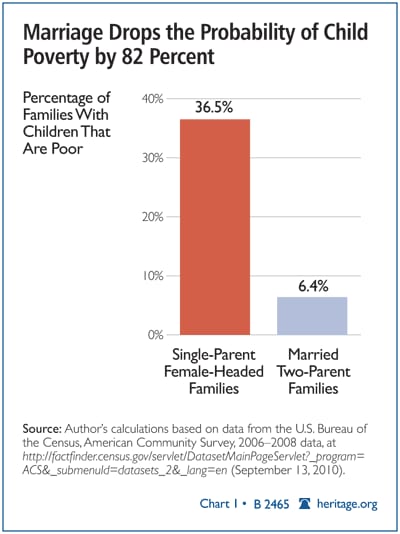
Child poverty is an ongoing national concern, but few are aware of its principal cause: the absence of married fathers in the home. According to the U.S. Census, the poverty rate for single parents with children in the United States in 2008 was 36.5 percent. The rate for married couples with children was 6.4 percent. Being raised in a married family reduced a child’s probability of living in poverty by about 80 percent. (See Chart below).
We know the statistics—that children who grow up without a father are five times more likely to live in poverty and commit crime; nine times more likely to drop out of schools and twenty times more likely to end up in prison. They are more likely to have behavioral problems, or run away from home, or become teenage parents themselves. And the foundations of our community are weaker because of it.

… and protection for their families.
Read this line in context →Scriptures
The design of the Nephites was to support … their wives, and their children, that they might preserve them from the hands of their enemies; and also … that they might worship God according to their desires. … The Nephites were inspired by a better cause, for … they were fighting for their homes and their … their wives and their children, and their all, yea, for their rites of worship. … For the Lord had said unto them, and also unto their fathers, … Ye shall not suffer yourselves to be slain by the hands of your enemies. … Ye shall defend your families even unto bloodshed. Therefore for this cause were the Nephites contending, … to defend themselves, and their families, … and their religion.
He was preparing to support … their wives, and their children, … and that they might live unto the Lord their God, and that they might maintain that which was called by their enemies the cause of Christians. … They could not suffer to lay down their lives, that their wives and their children should be massacred by the barbarous cruelty of those who … had gone to destroy them.
I speak unto you concerning your families—if men will smite you, or your families, once, and ye bear it patiently and revile not against them, neither seek revenge, ye shall be rewarded. … If that enemy shall escape my vengeance, … see to it that ye warn him in my name, that he come no more upon you, neither upon your family. … And then, if he shall come upon you or your children, … I have delivered thine enemy into thine hands. … If he has sought thy life, and thy life is endangered by him, thine enemy is in thine hands and thou art justified.
They were not half so numerous, … but they fought for their lives, and for their wives, and for their children; therefore they exerted themselves and like dragons did they fight.
David and his men came to the city, and, behold, it was burned with fire; and their wives, and their sons, and their daughters, were taken captives. … And David smote them [and] rescued his two wives. And there was nothing lacking to them, neither small nor great, neither sons nor daughters: … David recovered all.
As many as were brought to repentance … have taken up arms to defend themselves, and their wives, and children, and their lands.
God did visit us with assurances that he would deliver us; yea, insomuch that he did speak peace to our souls. … And we did take courage with our small force which we had received, and were fixed with a determination to conquer our enemies, and to maintain … our wives, and our children. … And thus we did go forth with all our might.
I did speak unto my people, and did urge them with great energy, that they would stand boldly before the Lamanites and fight for their wives, and their children, and their houses, and their homes. And my words did arouse them somewhat to vigor, insomuch that they did not flee from before the Lamanites, but did stand with boldness against them.
The angel of the Lord appeareth to Joseph in a dream, saying, Arise, and take the young child and his mother, and flee into Egypt, … for Herod will seek the young child to destroy him. When he arose, he took the young child and his mother by night, and departed into Egypt. … Then Herod … slew all the children that were in Bethlehem. … But when Herod was dead, … he arose, and took the young child and his mother, and came into the land of Israel. But when he heard that Archelaus did reign in Judæa in the room of his father Herod, he was afraid to go thither. … He turned aside into the parts of Galilee.
The father is the protector of the home. He guards it against the intrusion of evil from without. Formerly he protected his home with weapons and shuttered windows. Today the task is more complex. Barred doors and windows protect only against the intrusion of a corporeal creature. It is not an easy thing to protect one’s family against intrusions of evil into the minds and spirits of family members. These influences can and do flow freely into the home. Satan can subtly beguile the children of men in ways we have already mentioned in this conference. He need not break down the door. Fathers, you will have to live close to the Lord. Develop a sensitivity to the impressions of the Spirit.
A righteous father protects his children with his time and presence in their social, educational, and spiritual activities and responsibilities.
Scholarship
Complementarity even shows up in the way fathers hold infants. While a mother is likely to hold her infant to maximize eye contact and closeness, fathers are more likely to use a “football hold” — giving the child the same view of the world that he has. This way of holding parallels how fathers influence the way children relate to the world. Lack of father closeness is consistently associated with delinquent and criminal behaviors, while closeness is associated with empathy, happiness and relationship quality in adulthood. Even the way fathers roughhouse with children predicts less aggression, stronger peer relationships and greater popularity among peers.
Fathers also influence children’s brain development in complementary ways. Compared to mothers’, their interactions are more typically characterized by arousal, excitement and unpredictability in a way that stimulates openness to the world, exploration and discovery. …
Fathers are also more likely to encourage children in risk-taking and pursuing opportunities that facilitate educational and occupational achievement. And fathers typically encourage children in developing independence and finding solutions to their problems. Where mothers are more likely to reach in and help children solve a problem, fathers tend to hold back while still offering support, building capacity and confidence. These behaviors don’t always fit the traditional definition of “holding close and sensitively responding.” But a key part of nurturing is the capacity to “let go,” something fathers seem particularly good at preparing children to do. This helps explain why having an involved father is so strongly associated with earning good grades and graduating from college.
Although the current research cannot demonstrate causation, three converging lines of evidence suggest that the answer to this question is yes. First, in both the U.S. and New Zealand samples, there was a dose-response relationship between timing of onset of father absence and early sexual outcomes: Early father-absent girls had the highest rates of both early sexual activity and adolescent pregnancy, followed by late father-absent girls, followed by father-present girls. This dose-response relationship suggests that past research … has underestimated the impact of father absence on daughters’ sexual outcomes. This issue may be especially relevant to predicting rates of teenage pregnancy, which were 7 to 8 times higher among early father-absent girls, but only 2 to 3 times higher among late father-absent girls, than among father-present girls.
Fathers matter, and marriage helps to connect fathers to mothers and children.
Dads play particularly important roles in the formation of both their sons and their daughters. As Rutgers University sociologist David Popenoe explains, “The burden of social science evidence supports the idea that gender-differentiated parenting is important for human development and that the contribution of fathers to childrearing is unique and irreplaceable.”
Fathers provide four key pillars for child development: physical security, material resources, a distinctive contribution in forming the identity of the child, and the day-to-day nurture and care children need from their parents.
A 2019 meta-synthesis examined fathers’ experiences, needs, and perceptions of their involvement with their infants. Findings from this meta-synthesis showed that fathers’ relationship with their infants became stronger the more time and the more physical contact they had with their infant child. Moreover, their relationship with their wives and the level of support from them influenced the strength of their bond.
Also, the better their relationship with their own fathers the greater their desire to be involved with their infant child. However, most fathers reported that work commitments, sleep deprivation, perceived lack of caregiving skills, breastfeeding, and exclusion by healthcare professionals during labor and the early postpartum period hindered them from spending time with their infants, and made them feel left out.
Fathers who had skin-to-skin contact once their infant was born expressed their desire to be both the caregiver and provider, and altered their lifestyles, sacrificing their leisure time and hobbies, to be more physically and emotionally present with their infants.
A 2016 Korean study investigated the association between paternal involvement and the brain development of infants, aged 3 to 4 months. Results: fathers who take care of their infants by changing their diapers, feeding them, dressing them, and by providing emotional support to their wives increased their infants’ brain development (and decreased their wives’ stress levels). The mother’s level of stress modified both the depth of relationship of the father and their infants’ brain development.
A 2016 study using data from the Early Childhood Longitudinal Study examined 10,600 children to find out how father involvement affected developmental outcomes during the prenatal, perinatal, and infant stages. The results: infants with absent and/or uninvolved fathers had a greater likelihood of attention deficit and learning disorders, as well as speech and language disorders.
Mothers are primarily responsible for the nurture of their children.
Read this line in context →Scriptures
Unto the woman he said, … Thou shalt bring forth children; and thy desire shall be to thy husband.
Who can find a virtuous woman? for her price is far above rubies. … She seeketh wool, and flax, and worketh willingly with her hands. … She bringeth her food from afar. She riseth also while it is yet night, and giveth meat to her household. … She considereth a field, and buyeth it: with the fruit of her hands she planteth a vineyard. She girdeth her loins with strength, and strengtheneth her arms. She perceiveth that her merchandise is good: her candle goeth not out by night. She layeth her hands to the spindle. … She stretcheth out her hand to the poor. … She is not afraid of the snow for her household: for all her household are clothed with scarlet. … She maketh fine linen, and selleth it; and delivereth girdles unto the merchant. … She openeth her mouth with wisdom; and in her tongue is the law of kindness. She looketh well to the ways of her household, and eateth not the bread of idleness. Her children arise up, and call her blessed; her husband also. … Favour is deceitful, and beauty is vain: but a woman that feareth the LORD, she shall be praised. Give her of the fruit of her hands; and let her own works praise her in the gates.
I will therefore that the younger women marry, bear children, guide the house, give none occasion to the adversary to speak reproachfully.
The aged women likewise … may teach the young women to be sober, to love their husbands, to love their children, to be discreet, chaste, keepers at home.
Never had I seen so great courage. … For as I had ever called them my sons (for they were all of them very young) even so they said unto me: Father, behold our God is with us, and he will not suffer that we should fall; then let us go forth. … Now they never had fought, yet they did not fear death; and they did think more upon the liberty of their fathers than they did upon their lives; yea, they had been taught by their mothers, that if they did not doubt, God would deliver them. And they rehearsed unto me the words of their mothers, saying: We do not doubt our mothers knew it.
My dear sisters, your ability to discern truth from error, to be society’s guardians of morality, is crucial in these latter days. And we depend upon you to teach others to do likewise. Let me be very clear about this: if the world loses the moral rectitude of its women, the world will never recover.
As the father of 10 children—nine daughters and one son—and as President of the Church, I pray that you will sense how deeply I feel about you—about who you are and all the good you can do. No one can do what a righteous woman can do. No one can duplicate the influence of a mother.
A pernicious philosophy that undermines women’s moral influence is the devaluation of marriage and of motherhood and homemaking as a career. Some view homemaking with outright contempt, arguing it demeans women and that the relentless demands of raising children are a form of exploitation. They ridicule what they call “the mommy track” as a career. This is not fair or right. We do not diminish the value of what women or men achieve in any worthy endeavor or career—we all benefit from those achievements—but we still recognize there is not a higher good than motherhood and fatherhood in marriage. There is no superior career, and no amount of money, authority, or public acclaim can exceed the ultimate rewards of family.
Whatever else a woman may accomplish, her moral influence is no more optimally employed than here. A woman’s moral influence is nowhere more powerfully felt or more beneficially employed than in the home.
The calling of motherhood has been identified as the most ennobling endowment God could give His daughters, “as divinely called, as eternally important in its place as the priesthood itself.
If you are endowed but not currently married to a man who bears the priesthood and someone says to you, “I’m sorry you don’t have the priesthood in your home,” please understand that that statement is incorrect. You may not have a priesthood bearer in your home, but you have received and made sacred covenants with God in His temple. From those covenants flows an endowment of His priesthood power upon you. And remember, if your husband should die, you would preside in your home.
As a righteous, endowed Latter-day Saint woman, you speak and teach with power and authority from God. Whether by exhortation or conversation, we need your voice teaching the doctrine of Christ. We need your input in family, ward, and stake councils. Your participation is essential and never ornamental!
My dear sisters, your power will increase as you serve others. Your prayers, fasting, time in the scriptures, service in the temple, and family history work will open the heavens to you.
We know so little, brothers and sisters, about the reasons for the division of duties between womanhood and manhood as well as between motherhood and priesthood. These were divinely determined in another time and another place. We are accustomed to focusing on the men of God because theirs is the priesthood and leadership line. But paralleling that authority line is a stream of righteous influence reflecting the remarkable women of God who have existed in all ages and dispensations, including our own. Greatness is not measured by coverage in column inches, either in newspapers or in the scriptures. The story of the women of God, therefore, is, for now, an untold drama within a drama.
We men know the women of God as wives, mothers, sisters, daughters, associates, and friends. You seem to tame us and to gentle us, and, yes, to teach us and to inspire us. For you, we have admiration as well as affection, because righteousness is not a matter of role, nor goodness a matter of gender. In the work of the Kingdom, men and women are not without each other, but do not envy each other, lest by reversals and renunciations of role we make a wasteland of both womanhood and manhood.
Just as certain men were foreordained from before the foundations of the world, so were certain women appointed to certain tasks. Divine design—not chance—brought Mary forward to be the mother of Jesus.
Mothers have a sacred role. They are partners with God, as well as with their own husbands, first in giving birth to the Lord’s spirit children, and then in rearing those children so they will serve the Lord and keep his commandments.
Just as a mother’s body may be permanently marked with the signs of pregnancy and childbirth, the Savior said, ‘I have graven thee upon the palms of my hands’ (1 Nephi 21:15-16). For both a mother and the Savior, those marks memorialize a wrenching sacrifice- the sacrifice of begetting life-for her, physical birth; for him, spiritual rebirth.
— Elder Bruce C. Hafen and Marie K. Hafen,”Eve Heard All These Things and Was Glad” (1994)
source neededWe realize that some women, through no fault of their own, are not able to bear children. To these sisters, every prophet of God has promised that they will be blessed with children in the eternities and that posterity will not be denied them. Through pure faith, pleading prayers, fasting, and special priesthood blessings, many of these same sisters, with their noble companions at their sides, have had miracles take place in their lives and have been blessed with children. Others have prayerfully chosen to adopt children, and to these wonderful couples we salute you for the sacrifices and love you have given to those children you have chosen to be your own.
Women of God can never be like women of the world. The world has enough women who are tough; we need women who are tender. There are enough women who are coarse; we need women who are kind. There are enough women who are rude; we need women who are refined. We have enough women of fame and fortune; we need more women of faith. We have enough greed; we need more goodness. We have enough vanity; we need more virtue. We have enough popularity; we need more purity.
Mothers, teach your children the gospel in your own home, at your own fireside. This is the most effective teaching that your children will ever receive. This is the Lord’s way of teaching. The Church cannot teach like you can. The school cannot. The day-care center cannot. But you can, and the Lord will sustain you. Your children will remember your teachings forever, and when they are old, they will not depart from them…. This is your divine calling.
Motherhood is near to divinity. It is the highest, holiest service to be assumed by mankind. It places her who honors its holy calling and service next to the angels.
Women are endowed with special traits and attributes that come trailing down through eternity from a divine Mother. Young women have special God-given feelings about charity, love, and obedience. Coarseness and vulgarity are contrary to their natures. They have a modifying, softening influence on young men. Young women were not foreordained to do what priesthood holders do. Theirs is a sacred, God-given role, and the traits they received from Heavenly Mother are equally as important as those given to the young men.
Stories
Not yet migrated to YouTube — legacy format can’t play in-browser.
Open video in a new tab.mkv — download to view until migrated to YouTube
Scholarship
We now know that beginning in a child’s infancy, both fathers and mothers experience dramatic increases in “bonding hormones” but the same hormones elicit different responses. Mothers are predisposed to “coo and cuddle,” while fathers are predisposed to “tickle and toss.” Both are able to match their infant’s emotions and bond, but each offers different expressions in bonding that are critical for development.
A study of a large sample of Latter-day Saint parents found that a mother’s private religious behaviors – including fasting, personal prayer, scripture study, study of other religious materials, and thinking about religion – were more significant influence on the quality of her parenting than the family’s religious behaviors. Mothers who spend more time in these activities were more likely to feel close to their children and to be effective in providing warmth, love, and support, while setting clear and appropriate boundaries and expectations. They were also less likely to resort to physical coercion, verbal hostility, unreasonable punishing, indulgence, or psychological control – all unhealthy patterns of discipline in parenting. The finding suggest that humbly seeking for the Savior’s influence and help enables us to become the kinds of mothers we desire to become.
In spite of a dramatic increase since the 1950s in the percentage of employed mothers with children at home, national representative survey data consistently indicates that for mothers, the ideal work situation is not full-time employment. In fact, most mothers are working far more hours than they would prefer. Findings from The Motherhood Study appear much the same today as they did in 2005 — where 41% of mothers with children under age 18 were working full time, but only 15% of mothers with children in the home preferred to be.
When Judith Warner interviewed these women to find out why they chose to “opt-out” of professional work, in spite of significant opportunities she found that the experience of motherhood had reshaped their ambitions. They wanted to be able to experience motherhood “on their own terms,” to be able to be emotionally present, to able to give what they felt their children needed without feeling they were compromising professional responsibilities. In her words, “They have greater appreciation of some of the values of home and connectivity, which were somewhat alien to them in their high-flying professions.”
Children seems to do best when … mothers show love by communicating about and being aware of their activities and behaviors. Expressing love through listening, and communicating, and monitoring enables a mother to be warm and supportive while setting and enforcing appropriate limits. …Children’s academic success and healthy behaviors have also been tied to their mothers’ involvement in talking with them, listening to them, and answering their questions.
long-standing debate questions whether homemakers or working wives are happier. Drawing on cross-national data for 28 countries, this research uses multi-level models to provide fresh evidence on this controversy. All things considered, homemakers are slightly happier than wives who work fulltime, but they have no advantage over part-time workers. The work status gap in happiness persists even controlling for family life mediators. Cross-level interactions between work status and macro-level variables suggest that country characteristics–GDP, social spending, women’s labor force participation, liberal gender ideology and public child care–ameliorate the disadvantage in happiness for full-time working wives compared to homemakers and part-time workers. …Societal factors that help to ease work-family conflict or decouple living standards from wife’s work status may improve the relative happiness of full-time working women. … With homemakers holding their own, Betty Friedan’s (1963) notion that homemaking is quiet death lends no support today.
We know the source but not the exact wording — follow the link to read it there.
A large body of research addresses the effects on children when mothers have to spend many hours away from them in employment. These studies provide evidence for the importance of mothers spending time with their children, but they also indicate that it is the way a mother interacts with her children when she is with them that is most important. Extensive hours of non-mother childcare (30 hours per week) during the early years of a child’s life have been associated, on average, with less social competence and cooperation, more problem behaviors, negative mood, aggression, and conflict in children. …
But the way a mother interacted with her children—maternal sensitivity—was the strongest, most consistent predictor of children’s social-emotional development and behavior, even when she was away from them for long periods of time.
Decades of scientific and psychological study provide overwhelming evidence for the idea that “mother love” has an enormous, permanent impact in shaping the character and life of a child. Mother love shapes cultures and individuals. While most mothers know that their love and emotional availability are vital to their children’s well-being, many of us do not understand the profound and long-lasting impact we have in developing our young children’s brains, teaching them first lessons of love, shaping their consciences … despite at a time when society urges women to seek their worth and personal fulfillment in things that take them away from their families and intimate bonds.
Although scientific evidence has continued to demonstrate the importance of a mother’s care, motherhood has been questioned and devalued in the broader culture. A survey of a nationally representative sample of mothers in the United States in 2005 found that fewer than half of mothers (48%) felt appreciated most of the time, and almost 20% felt less valued by society when they became a mother (M. F. Erickson & Aird, 2005). Many mothers feel that society does not value the kind of self-sacrificing work motherhood requires. As a result, they may feel pressured to invest their talents and energies in work that they perceive to be more valued by the larger culture. … Bruce C. Hafen explained, “For most of our history, the word motherhood meant honor, endearment, and sacrifice. …Yet this spirit of self-sacrifice has become a contentious issue in recent years, making contentious the very idea of motherhood.”
In these sacred responsibilities, fathers and mothers are obligated to help one another as equal partners.
Read this line in context →Scriptures
God said, It is not good that the man should be alone; I will make him an help meet for him. … For Adam there was not found an help meet for him. And the Lord God … took one of [Adam’s] ribs. … And the rib, which the Lord God had taken from man, made he a woman, and brought her unto the man. And Adam said, This is now bone of my bones, and flesh of my flesh: she shall be called Woman, because she was taken out of Man.
Adam began to till the earth. … And Eve, also, his wife, did labor with him. … The sons and daughters of Adam began to divide two and two in the land, and to till the land, and to tend flocks. … And Adam and Eve blessed the name of God, and they made all things known unto their sons and their daughters.
Let the husband render unto the wife due benevolence: and likewise also the wife unto the husband. … What knowest thou, O wife, whether thou shalt save thy husband? or how knowest thou, O man, whether thou shalt save thy wife?
He that is married careth for the things that are of the world, how he may please his wife. … She that is married careth for the things of the world, how she may please her husband.
Neither is the man without the woman, neither the woman without the man, in the Lord.
Thy calling shall be for a comfort unto … thy husband, in his afflictions, with consoling words, in the spirit of meekness. … And thou shalt be ordained … to expound scriptures, and to exhort the church, according as it shall be given thee by my Spirit. … Thy time shall be given to writing, and to learning much. And thou needest not fear, for thy husband shall support thee in the church. … Continue in the spirit of meekness, and beware of pride. Let thy soul delight in thy husband.
Be filled with the Spirit, … submitting yourselves one to another in the fear of God. Wives, submit yourselves unto your own husbands, as unto the Lord. For the husband is the head of the wife, even as Christ is the head of the church: and he is the saviour of the body. … Husbands, love your wives, even as Christ also loved the church, and gave himself for it. … So ought men to love their wives as their own bodies. He that loveth his wife loveth himself. For no man ever yet hated his own flesh; but nourisheth and cherisheth it. … Let every one of you in particular so love his wife even as himself; and the wife see that she reverence her husband.
Every woman and every man who makes covenants with God and keeps those covenants, and who participates worthily in priesthood ordinances, has direct access to the power of God. Those who are endowed in the house of the Lord receive a gift of God’s priesthood power by virtue of their covenant, along with a gift of knowledge to know how to draw upon that power.
The heavens are just as open to women who are endowed with God’s power flowing from their priesthood covenants as they are to men who bear the priesthood. I pray that truth will register upon each of your hearts because I believe it will change your life. Sisters, you have the right to draw liberally upon the Savior’s power to help your family and others you love.
It thrills me when I learn of priesthood leaders who eagerly seek the participation of women in ward and stake councils. I am inspired by each husband who demonstrates that his most important priesthood responsibility is to care for his wife. I praise that man who deeply respects his wife’s ability to receive revelation and treasures her as an equal partner in their marriage. …
There is no better setting for rearing the rising generation than the traditional family, where a father and a mother work in harmony to provide for, teach, and nurture their children. Where this ideal does not exist, people strive to duplicate its benefits as best they can in their particular circumstances.”
As centuries and then millennia came and went [after the fall], the clarity of men’s and women’s inspired and interdependent contributions became clouded with misinformation and misunderstandings. During the time between that marvelous beginning in the Garden of Eden and now, the adversary has been quite successful in his goal to divide men and women in his attempts to conquer our souls. Lucifer knows that if he can damage the unity men and women feel, if he can confuse us about our divine worth and covenant responsibilities, he will succeed in destroying families, which are the essential units of eternity.
Satan incites comparison as a tool to create feelings of being superior or inferior, hiding the eternal truth that men’s and women’s innate differences are God given and equally valued. He has attempted to demean women’s contributions both to the family and in civil society, thereby decreasing their uplifting influence for good. His goal has been to foster a power struggle rather than a celebration of the unique contributions of men and women that complement one another and contribute to unity.
One of the keys is to understand that when women and men work together, we accomplish a great deal more than we do working separately. Our roles are complementary rather than competitive. … Becoming more in tune with the divine pattern of working together in unity is critical in this day of “me first” messages that surround us. Women do possess distinctive, divine gifts and are given unique responsibilities, but those are not more—or less—important than men’s gifts and responsibilities. All are designed and needed to bring about Heavenly Father’s divine plan to give each of His children the best opportunity to fulfill his or her divine potential.
Husbands and wives are equal partners. They have different but complementary responsibilities. The wife may bear children, which blesses the entire family. The husband may receive the priesthood, which blesses the entire family. But in family council, wives and husbands, as equal partners, make the most important decisions. They decide how the children will be taught and disciplined, how money will be spent, where they will live, and many other family decisions. These are made jointly after seeking guidance from the Lord. The goal is an eternal family.
In fulfilling their marriage covenant, husbands and wives perform distinct but complementary roles. “A home with a loving and loyal husband and wife is the supreme setting in which children can be reared in love and righteousness and in which the spiritual and physical needs of children can be met. Just as the unique characteristics of both males and females contribute to the completeness of a marriage relationship, so those same characteristics are vital to the rearing, nurturing, and teaching of children.”
As husbands and wives “lose” their lives in fulfilling these sacred duties of marriage and family, they find themselves—becoming true servants of God and disciples of Jesus Christ.
Perhaps we should define helpmeet. You must not misunderstand what the Lord meant when Adam was told he was to have a helpmeet. A helpmeet is a companion suited to or equal to us. We walk side by side with a helpmeet, not one before or behind the other. A helpmeet results in an absolute equal partnership between a husband and a wife. Eve was to be equal to Adam as a husband and wife are to be equal to each other.
And I, the Lord God, said unto mine Only Begotten, that it was not good that the man should be alone; wherefore, I will make an help meet for him” (Moses 3:18).
Here we see that one of the simple truths from heaven is that it is not good that man or woman should be alone. He or she is to have a helpmeet. Few, if any, simple truths from heaven are more important to us than the knowledge that we are to have a helpmeet for us, a wife for a man or a husband for a woman.
In some cultures, tradition places a man in a role to dominate, control, and regulate all family affairs. That is not the way of the Lord. In some places the wife is almost owned by her husband, as if she were another of his personal possessions. That is a cruel, unproductive, mistaken vision of marriage encouraged by Lucifer that every priesthood holder must reject. It is founded on the false premise that a man is somehow superior to a woman. Nothing could be farther from the truth.
In the Church there is a distinct line of authority. We serve where called by those who preside over us. In the home it is a partnership with husband and wife equally yoked together, sharing in decisions, always working together. While the husband, the father, has responsibility to provide worthy and inspired leadership, his wife is neither behind him nor ahead of him but at his side.
Since the beginning, God has instructed mankind that marriage should unite husband and wife together in unity. Therefore, there is not a president or a vice president in a family. The couple works together eternally for the good of the family. They are united together in word, in deed, and in action as they lead, guide, and direct their family unit. They are on equal footing. They plan and organize the affairs of the family jointly and unanimously as they move forward.
Every father is to his family a patriarch and every mother a matriarch as coequals in their distinctive roles.
The order of priesthood spoken of in the scriptures is sometimes referred to as the patriarchal order because it came down from father to son. But this order is otherwise described in modern revelation as an order of family government where a man and woman enter into a covenant with God—just as did Adam and Eve—to be sealed for eternity, to have posterity, and to do the will and work of God throughout their mortality.
There is no task, however menial, connected with the care of babies, the nurturing of children, or with the maintenance of the home that is not [the husband’s] equal obligation.
Stories

We know the source but not the exact wording — follow the link to read it there.
Because the gospel has been a source of power and encouragement in my life as a woman, I have been confused by this scripture verse: “And the Lord God said, It is not good that the man should be alone; I will make him an help meet for him” (Genesis 2:18).
To me, a “help meet” sounded like a sidekick, like someone filling a lower, supporting role. In fact, throughout history this phrase has often been used to justify the claim that women were created to serve in a subservient position. For example, one of the interpretations for “help meet” proposed by 18-century biblical scholar John Gill was that a woman’s purpose as a “help meet” was to make man “comfortable … to dress his food … be pleasing to his sight, and … be in all respects … entirely answerable to his … wants and wishes.”
This interpretation did not match my knowledge of God’s views of women! I knew that God doesn’t see me as an assistant or sidekick with a role to merely please others and fill their wishes. But even though I knew this in my heart, seeing that verse in my scriptures felt uncomfortable.
Things changed one day when I learned more about the Hebrew words translated as “help meet” in the King James Version of the Bible.
Ezer Kenegdo source needed
- “For the God of my father, said he, was mine help [ezer], and delivered me from the sword of Pharaoh” (Exodus 18:4).
- “Happy art thou, O Israel … saved by the Lord, the shield of thy help [ezer]” (Deuteronomy 33:29).
- “But I am poor and needy: make haste unto me, O God: thou art my help [ezer] and my deliverer” (Psalm 70:5).
- “O Israel, trust thou in the Lord: he is their help [ezer] and their shield” (Psalm 115:9).
- “My help [ezer] cometh from the LORD, which made heaven and earth” (Psalm 121:2).
- “In me [the Lord] is thine help [ezer]” (Hosea 13:9).
source neededMen and women are equal partners in their marriage, but how does this play out in when a financial crisis hits close to home? As part of our storytelling series, Teresa shares how she came to learn just how important it is for a “husband and wife have a solemn responsibility to love and care
People of the Proclamation: Teresa’s Story

Scholarship
Research has demonstrated that couples who have an equal partnership have happier relationships, better individual well-being, more effective parenting practices, and better-functioning children. Researchers have consistently found that couples who share power are more satisfied and have better overall marital quality than couples where one spouse dominates.
An important reason for equal partners having greater satisfaction is that they have less negative interaction and more positive interaction in their relationship. In addition, couples that are equal partners are significantly less likely to experience verbal aggression and physical violence. Moreover, there is evidence that equal partners are more satisfied with the quality of the physical intimacy in their relationship. …
There is substantial evidence that spouses who feel that they lack influence in their relationship—those who don’t have a voice—are more likely to experience symptoms of depression.
Just as the complementarity of a man and a woman is important for the type of union they can form, so too is it important for how they raise children. There is no such thing as “parenting.” There is mothering, and there is fathering, and children do best with both. While men and women are each capable of providing their children with a good upbringing, there are, on average, differences in the ways that mothers and fathers interact with their children and the functional roles that they play.
Rutgers University sociologist David Popenoe explains:
The burden of social science evidence supports the idea that gender-differentiated parenting is important for human development and that the contribution of fathers to childrearing is unique and irreplaceable. …We should disavow the notion that “mommies can make good daddies,” just as we should disavow the popular notion…that “daddies can make good mommies.”… The two sexes are different to the core, and each is necessary—culturally and biologically—for the optimal development of a human being.
Resources
Gender equality is not some gratuitous element of God’s vision of marriage; rather, we are commanded to presume the equality of our spouse as we approach the marriage altar, for otherwise we cannot truly love her or him. It is hoped that we then deepen that vision of our spouse’s equality in the divine work that is procreation and parenthood. Indeed, given that we believe Adam and Eve lived this law, a marriage reflecting the equality of the spouses is the ultimate traditional marriage.
The right of men and women of marriageable age to marry and to found a family shall be recognized and that husband and wife should be equal partners.
Disability, death, or other circumstances may necessitate individual adaptation.
Read this line in context →Scriptures
Naomi’s husband died, … and her two sons … died also both of them; and the woman was left of her two sons and her husband. … Ruth the Moabitess said unto Naomi, Let me now go to the field, and glean ears of corn after him in whose sight I shall find grace. And she said unto her, Go, my daughter. And she went, and came, and gleaned in the field after the reapers. … So she gleaned in the field until even, and beat out that she had gleaned: and it was about an ephah of barley. … And her mother in law saw and [Ruth] … gave to her that she had reserved after she was sufficed. … So she kept fast by the maidens of Boaz to glean unto the end of barley harvest and of wheat harvest; and dwelt with her mother in law.
David [fled] for fear of Saul. … David therefore departed thence, and escaped to the cave Adullam: and when his brethren and all his father’s house heard it, they went down thither to him. … And David went thence to … Moab: and he said unto the king of Moab, Let my father and my mother, I pray thee, come forth, and be with you, till I know what God will do for me. And he brought them before the king of Moab: and they dwelt with him all the while that David was in the hold.
In these days came prophets from Jerusalem unto Antioch … and signified by the Spirit that there should be great dearth. … Then the disciples, every man according to his ability, determined to send relief unto the brethren which dwelt in Judæa: which also they did, and sent it to the elders.
There was a great number of women, more than there was of men; therefore king Limhi commanded that every man should impart to the support of the widows and their children, that they might not perish with hunger; and this they did because of the greatness of their number that had been slain.
It is the duty of the church to assist in supporting the families of those, and also to support the families of those who are called and must needs be sent unto the world to proclaim the gospel unto the world. … Obtain places for your families, inasmuch as your brethren are willing to open their hearts. And let all such as can obtain places for their families, and support of the church for them, not fail to go into the world.
Let all the people of the Church … and those who journey with them, be organized into companies, with a covenant. … Let them go to with their might, to prepare for those who are to tarry. … Let each company bear an equal proportion … in taking the poor, the widows, the fatherless, and the families of those who have gone into the army, that the cries of the widow and the fatherless come not up into the ears of the Lord against this people. Let each company prepare houses, and fields for raising grain, for those who are to remain behind this season; and this is the will of the Lord concerning his people. If ye do this with a pure heart, in all faithfulness, … you shall be blessed … in your houses, and in your families.
There is no better setting for rearing the rising generation than the traditional family, where a father and a mother work in harmony to provide for, teach, and nurture their children. Where this ideal does not exist, people strive to duplicate its benefits as best they can in their particular circumstances.
There are so many, young and old, who are loyal and true to the gospel of Jesus Christ, even though their own current experience does not fit neatly inside the family proclamation: children whose lives have been shaken by divorce; youth whose friends mock the law of chastity; divorced women and men who have been gravely wounded by the unfaithfulness of a spouse; husbands and wives who are unable to have children; women and men who are married to a spouse who does not share their faith in the restored gospel; single women and men who, for various reasons, have been unable to marry.
One friend of nearly 20 years, whom I admire greatly, is not married because of same-sex attraction. He has remained true to his temple covenants, has expanded his creative and professional talents, and has served nobly in both the Church and the community. He recently said to me, “I can sympathize with those in my situation who choose not to keep the law of chastity in the world in which we live. But didn’t Christ ask us to be ‘not of this world’? It is clear that God’s standards are different from those of the world.”
We need to recognize the hard mortal realities in all of this and must use common sense and guidance by personal revelation. Some will not marry in this life. Some marriages will fail. Some will not have children. Some children will choose not to respond to even the most devoted and careful nurturing by loving parents. In some cases, health and faith may falter. Some who would rather remain at home may have to work. Let us not judge others, because we do not know their situation nor do we know what common sense and personal revelation have led them to do. We do know that throughout mortality, women and men will face challenges and tests of their commitment to God’s plan for them. We need to remember that trials and temptations are an important part of our lives. We should not criticize others for the way they choose to exercise their moral agency when faced with adversity or affliction.”
Not all Heavenly Father’s children have the opportunity in this life to experience sexual intimacy in married relationships according to God’s law. Some will not have the opportunity to marry. Others are convinced that their unique circumstances make living the law of chastity so challenging and unfair that they can choose to ignore it.
Fairness, however, must be judged from an eternal perspective, from that of Heavenly Father and Jesus Christ. The Savior exhorted His people to withhold judgment on what is fair or unfair until that day when He makes up His jewels (see Malachi 3:17–18). The “jewels” the Savior references are those who, despite perceived or temporary unfairness or any other impediment, keep His commandments.”
We have a divine pattern to follow as outlined in ‘The Family: A Proclamation to the World,’ but we know that mortality can be complicated. … Each of you must come to know what the Lord wants for you individually, given the choices before you. Sister Julie B. Beck said, “The ability to qualify for, receive, and act on personal revelation is the single most important skill that can be acquired in this life.” I agree with her.
Once you know the Lord’s will, you can then move forward in faith to fulfill your individual purpose. One sister may be inspired to continue her education and attend medical school, allowing her to have significant impact on her patients and to advance medical research. For another sister, inspiration may lead her to forego a scholarship to a prestigious institution and instead begin a family much earlier than has become common in this generation, allowing her to make a significant and eternal impact on her children now.
Is it possible for two similarly faithful women to receive such different responses to the same basic questions? Absolutely! What’s right for one woman may not be right for another. That’s why it is so important that we should not question each other’s choices or the inspiration behind them. And we should refrain from asking hurtful and unsupportive questions like “Why are you going on a mission?” or “Why aren’t you on a mission?” or “Why aren’t you married?” or “Why don’t you have children?” We can all be kinder and more thoughtful of the situations in which our sisters throughout the world find themselves as they seek to follow the will of our Heavenly Father in their individual lives.
Some will say, “You don’t understand my situation.” I may not, but I testify that there is One who does understand. There is One who knows your burdens because of His sacrifice made in the garden and on the cross. As you seek Him and keep His commandments, I promise you that He will bless you and lift the burdens too heavy to bear alone. He will give you eternal friends and opportunities to serve. More important, He will fill you with the powerful Spirit of the Holy Ghost and shine His heavenly approval upon you. No choice, no alternative that denies the companionship of the Holy Ghost or the blessings of eternity is worthy of our consideration.
We realize that some women, through no fault of their own, are not able to bear children. To these lovely sisters, every prophet of God has promised that they will be blessed with children in the eternities and that posterity will not be denied them.
We recognize the agony of men who are unable to find ways and means adequately to sustain their families. There is no shame for those who, at a given moment, despite their best efforts, cannot fulfill all the duties and functions of fathers. “Disability, death, or other circumstances may necessitate individual adaptation. Extended families should lend support when needed.
Stories
Not yet migrated to YouTube — playing from the legacy site.
Scholarship
Identifying processes and mechanisms that help single mothers function well, despite the challenges they face, may be the best approach to improving the lives of children in single mother families. … Single mothers with higher social support exhibit higher positive parenting behaviors, lower depression and anxiety, higher self-efficacy, warmer relationships with their children.
Findings suggest that, like many other difficult experiences and events in the lives of individuals and couples, adaptation to unintentional biological childlessness is a slow and painful process of pursuing solutions; considering options; grieving losses; redefining the self, family, and the future; eventually being able to realize and appreciate the gains of having survived infertility; and, ultimately, reconstructing positive self-conceptions and a meaningful life without biological children. … These comments underscore the importance of an empathic, nonjudgmental posture as counselors bear witness to the struggles of couples to reconstruct their lives when they are unable to achieve what many of us take for granted—the goal of producing a child.
Extended families should lend support when needed.
Read this line in context →Scriptures
Isaac called Jacob, and blessed him, and charged him, and said unto him, … Go to … the house of Bethuel thy mother’s father. … God Almighty bless thee, … that thou mayest inherit the land wherein thou art a stranger. … And Isaac sent away Jacob: and he went … unto Laban, son of Bethuel, … the brother of Rebekah, Jacob’s and Esau’s mother.
If thy brother be waxen poor, and hath sold away some of his possession, and if any of his kin come to redeem it, then shall he redeem that which his brother sold. … And if … thy brother that dwelleth by him wax poor, and sell himself unto the stranger, … one of his brethren may redeem him: either his uncle, or his uncle’s son, may redeem him, or any that is nigh of kin unto him of his family may redeem him; or if he be able, he may redeem himself.
The daughters of Zelophehad speak right. … If a man die, and have no son, then ye shall cause his inheritance to pass unto his daughter. And if he have no daughter, then ye shall give his inheritance unto his brethren, … [or] unto his father’s brethren, … [or] unto his kinsman that is next to him of his family.
There was a certain Jew, whose name was Mordecai, … who had been carried away from Jerusalem with the captivity. … And he brought up Hadassah, that is, Esther, his uncle’s daughter: for she had neither father nor mother, … whom Mordecai, when her father and mother were dead, took for his own daughter. … Esther, the daughter of … the uncle of Mordecai, who had taken her for his daughter, … obtained favour.
When he was twelve years old, … the child Jesus tarried behind in Jerusalem; and Joseph and his mother knew not of it. … And they sought him among their kinsfolk.
Their intentions of mobbing us were only counteracted by the influence of my wife’s father’s family (under Divine providence), who had become very friendly to me, and who were opposed to mobs, and were willing that I should be allowed to continue the work of translation without interruption; and therefore offered and promised us protection from all unlawful proceedings, as far as in them lay.
Jeremiah the prophet was shut up in the court of the prison. … And Jeremiah said, … So Hanameel mine uncle’s son came to me in the court of the prison according to the word of the Lord.
Naomi’s husband died, … and her two sons … died also both of them; and the woman was left of her two sons and her husband. … But Ruth clave unto her. … And Ruth said, Intreat me not to leave thee, or to return from following after thee: for whither thou goest, I will go; and where thou lodgest, I will lodge: thy people shall be my people, and thy God my God: where thou diest, will I die, and there will I be buried: the Lord do so to me, and more also, if ought but death part thee and me.
Naomi had a kinsman of her husband’s, a mighty man of wealth, of the family of Elimelech; and his name was Boaz. And Ruth—… her hap was to light on a part of the field belonging unto Boaz, who was of the kindred of Elimelech. … Then said Boaz unto Ruth, My daughter, … abide here fast by my maidens: let thine eyes be on the field that they do reap. … Have I not charged the young men that they shall not touch thee? and when thou art athirst, … and drink of that which the young men have drawn. … It hath fully been shewed me, all that thou hast done unto thy mother in law since the death of thine husband. … At mealtime come thou hither, and eat of the bread, and dip thy morsel in the vinegar. … And he reached her parched corn, and she did eat, and was sufficed. … Boaz commanded his young men, saying, Let her glean even among the sheaves, and reproach her not: and let fall also some of the handfuls of purpose for her, and leave them, that she may glean them. … And Naomi said unto her, The man is near of kin unto us, one of our next kinsmen. … It is good, my daughter, that thou go out with his maidens, that they meet thee not in any other field. So she kept fast by the maidens of Boaz to glean unto the end of barley harvest and of wheat harvest; and dwelt with her mother in law.
[Boaz said] It is true that I am thy near kinsman. … Then will I do the part of a kinsman to thee, as the Lord liveth. … And the women said unto Naomi, Blessed be the LORD, which hath not left thee this day without a kinsman.
Marcus [was] sister’s son to Barnabas. … Barnabas [was] of the country of Cyprus. … And Barnabas and Saul returned from Jerusalem … and took with them … Mark. … The Holy Ghost said, Separate me Barnabas and Saul for the work. … So they … sailed to Cyprus. … And they had also John [Mark] to their minister. And some days after Paul said unto Barnabas, Let us go again and visit our brethren in every city where we have preached. … And Barnabas determined to take with them … Mark. … So Barnabas took Mark, and sailed unto Cyprus.
Certain of the Jews banded together, … saying that they would neither eat nor drink till they had killed Paul. And they were more than forty which had made this conspiracy. … When Paul’s sister’s son heard of their lying in wait, he went and entered into the castle, and told Paul.
Thou shalt bring thy father, and thy mother, and thy brethren, and all thy father’s household, home unto thee. … And whosoever shall be with thee in the house, [no] hand [will] be upon him. … And the young men that were spies went in, and brought out Rahab, and her father, and her mother, and her brethren, and all that she had; and they brought out all her kindred.
He said, I am Joseph your brother, whom ye sold into Egypt. … God sent me before you to preserve you a posterity in the earth, and to save your lives. … [Say] to my father, … Come down unto me, … and thou shalt be near unto me, thou, and thy children, and thy children’s children. … And there will I nourish thee; for yet there are five years of famine; lest thou, and thy household, and all that thou hast, come to poverty. … And Joseph gave them wagons [and] provision for the way. To all of them he gave each man changes of raiment. … And the sons … carried Jacob their father, and their little ones, and their wives. … His sons, and his sons’ sons with him, his daughters, and his sons’ daughters, and all his seed brought he with him. … All the souls of the house of Jacob, which came into Egypt, were threescore and ten. … And Joseph placed his father and his brethren, and gave them a possession in the land of Egypt, in the best of the land. … And Joseph nourished his father, and his brethren, and all his father’s household, with bread, according to their families.
Jethro, Moses’ father in law, took Zipporah, Moses’ wife, after he had sent her back, and her two sons, … [and] came with his sons and his wife unto Moses … at the mount of God. … And Moses went out to meet his father in law, … and they asked each other of their welfare. … And when Moses’ father in law saw all that he did to the people, he said, … Why sittest thou thyself alone? … Thou wilt surely wear away, … for this thing is too heavy for thee; thou art not able to perform it thyself alone. … I will give thee counsel. … So shall it be easier for thyself, and they shall bear the burden with thee.
The angel … said unto her, … [There] shall be born of thee … the Son of God. And, behold, thy cousin Elisabeth, she hath also conceived. … And Mary arose … and entered into the house of Zacharias, and saluted Elisabeth. And … when Elisabeth heard the salutation of Mary, the babe leaped in her womb; and Elisabeth was filled with the Holy Ghost. … And Mary abode with her about three months. … Now Elisabeth … brought forth a son. And her neighbours and her cousins … rejoiced with her.
Nephi gave me, Jacob, a commandment concerning the small plates, upon which these things are engraven. And he gave me, Jacob, a commandment that I should write upon these plates.
I did deliver the plates unto my brother Chemish. Now I, Chemish, write what few things I write, in the same book with my brother. … After this manner we keep the records, for it is according to the commandments of our fathers.
David[‘s] sisters were Zeruiah. … And the sons of Zeruiah; Abishai, and Joab, and Asahel, three. … David abode in the wilderness, and he saw that Saul came after him into the wilderness. … Then answered David and said … to Abishai the son of Zeruiah, … Who will go down with me to Saul to the camp? And Abishai said, I will go down with thee. … And there was a very sore battle [won by] the servants of David. And there were three sons of Zeruiah there, Joab, and Abishai, and Asahel.
Each of us should do all that we can, in the spirit of gospel self-reliance, to provide for ourselves and our families in a temporal and a spiritual way. Then, if it is necessary to reach out for help, we know we have first done all that we can. This includes helping the members of our immediate and extended families to the maximum extent possible so that the bishop is not faced with burdens that should be handled in the first instance by the individual or by the extended family.
The purpose of the welfare program is to care for the poor and the needy and make the members of the Church, by their obedience to gospel principles, strong and self-reliant. At the center of caring for the poor and the needy in a worldwide church is a generous contribution to the fast offerings, and personal and family preparedness. At the very heart of taking care of our own needs is our own energy and ability, with help to and from our own families.
Stories
There are many family relationships that can be sacred stewardships. Brothers, sisters, aunts, uncles, cousins, in-laws, and others can be uniquely influential. “Extended families should lend support when needed.” Fostering these family connections can bring needed support and become prized relationships.
The scriptures are full of examples of righteous men and women who made a significant difference in the lives of their extended family. Abraham changed Lot’s life as his uncle. Joseph of Egypt saved his brothers and their families. As adults, sisters Mary and Martha blessed each other and their brother, Lazarus. Ruth, as a daughter-in-law, sustained Naomi and then was eternally blessed in return by Naomi’s counsel. Elisabeth and Mary supported each other as cousins through the challenges surrounding their pregnancies. Even Zoram, who was not related by blood, was such a faithful support to Nephi that he and his children were adopted as if they were family. This broader view of family is so important to so many who have so much to give but feel cut off because they don’t have the nuclear family they want.
One significant role that grandparents and extended family members play is to provide extra support that children need when parents have to work, care for siblings, or just need a break. This can be sharing in childcare duties or just providing support and guidance.
Healthy relationships with grandparents yield many benefits for children:
- Someone who offers unconditional love
- A mentor who can help with problems
- Kindness, humor, and patience
- Family traditions
- Learning about life lessons
It’s important for parents and extended family to agree on their role in their children’s lives. Grandparents need to remember that they are not the parents and decisions are not theirs to make.
Grandparents and family who live far away can maintain a close relationship by phone calls, writing letters, Skyping, and emailing between visits.
— Right from the Start NJ
source needed
Scholarship
Those receiving support from their family members may feel a greater sense of self-worth, and this enhanced self-esteem may be a psychological resource, encouraging optimism, positive affect, and better mental health.
There is now a growing body of research that illustrates that grandparent involvement is associated with improved mental health, improved resilience and pro-social behaviour in grandchildren. For instance, an earlier study by Buchanan & Flouri (2008) found that adolescents whose closest grandparent was involved in their lives following their parents’ separation or divorce, reported fewer emotional symptoms and more pro-social behaviours than those with less grandparent involvement. … It is remarkable that across these very different settings, results show that grandparent involvement was associated with positive outcomes for children. Frequent or emotionally close contacts between a grandchild and a grandparent may protect against developmental problems and boost a child’s cognitive and social abilities.
Extended family has a positive impact on children’s educational attainment. “In addition to siblings resembling each other, first cousins also resemble each other with regard to how much education they complete.” Aunts, uncles, and grandparents may help children to be more resilient, by compensating for resources that may be lacking in their immediate family.